Latin American Herald Tribune reports Venezuela’s first shipment of 160 – 180 tonnes of gold held abroad was received at Maiquetia International Airport outside Caracas on Friday night.
In operation that also involved tanks and aircraft, the first of some 15,000 standard 400-ounce bars wrapped in black plastic inside a caravan of armoured vehicles escorted by 500 soldiers then made its way to the bank’s headquarters downtown. President Hugo Chavez announced in August that the South American country plans to repatriate its gold reserves held by banks in England, the US, Canada and France. The Central Bank of Venezuela already holds 154 tons of bullion domestically.
Latin American Herald Tribune reports aircraft and tanks were aslo involved in safeguarding the shipment according to General Silva of the country’s strategic operational command. “Each box of gold weighs 500 kilograms and is worth about $30 million,” president of Venezuela’s central bank, Nelson Merentes told gathered crowds. The country held 211 tons – nearly $11 billion worth – of its 365 tonnes of gold reserves abroad. Venezuela has the largest gold reserves in South America.
CTV reported in August Venezuela would need to transport the gold in several trips, traders said, since the high value of gold means it would be impossible to insure a single aircraft carrying 211 tonnes. It could take about 40 shipments to move the gold back to Caracas, traders estimated.
While billions of dollars worth of gold is traded every day, only a tiny proportion of it moves from vaults in London, New York and Zurich. Read more on the logistics of moving such vast amounts of gold.
http://www.mining.com/2011/11/27/chavez-calls-in-troops-to-move-first-of-15000-gold-bars-to-caracas-central-bank/
goldsilver.com

Monday, November 28, 2011

Saturday, November 19, 2011
Top 1 Percent Control 42 Percent of Financial Wealth in the U.S. – How Average Americans are Lured into Debt Servitude by Promises of Mega Wealth.
Many Americans are still struggling at the depths of this recession. We have 37 million Americans on food stamps and many wait until midnight of the last day of the month so checks can clear to buy food at Wal-Mart. Do you think these people are starring at the stock market? The overall data is much worse:
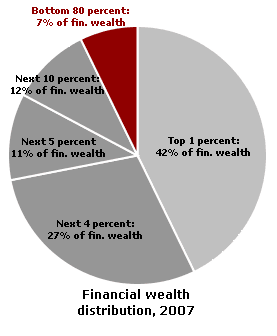
Source: William Domhoff
If we break the data down further we will find that 93 percent of all financial wealth is controlled by the top 10 percent of the country. That is why these people are cheering their one cent share increase while layoffs keep on improving the bottom line. But what bottom line are we talking about here? The Wall Street crowd would like you to believe that all is now good that the stock market has rallied 60+ percent. Of course they are happy because they control most of this wealth. Yet the typical American still has negative views on the economy because they actually have to work to earn a living:
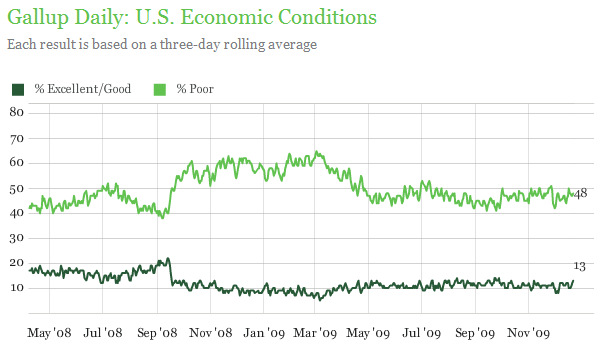
The above daily poll asks Americans about their view on the health of the economy. Only 13 percent believe the economy is good or excellent. Funny how that correlates with the top 10 percent who control 93 percent of wealth. Many Americans were sold the illusion of the bubble. They were sold on the idea that their homes were worth so much more than they really were. And many used this phony wealth effect to go out and spend beyond their means. They started spending as if they were part of this elite 10 percent crowd. But once the tide rolled out, it was clear they were not. And the horribly built bailouts demonstrate who is controlling our political system. This was not the rule of a capitalist system but a corporate run government.
Just think about the bailouts and which companies were saved. We ended up bailing out the worst performing and troubled companies thus keeping alive companies that should have completely failed. Did we bail out Google? Proctor and Gamble? Of course not. These companies actually produce something that people want. Banks and especially the Wall Street kind merely keep that 42 percent happy by making sure their stock values stay high so they can keep on making money while the average Americans is sold up the river.
Yet many were brought into the easy money fold by going into massive amounts of debt. And who has most of the debt? That is right, the average American:
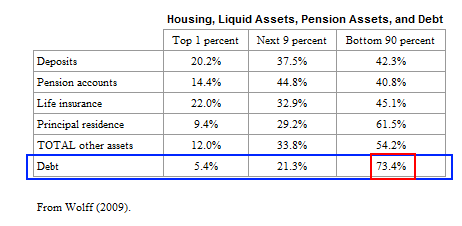
The bottom 90 percent have been saddled with 73 percent of all debt. In other words much of their so-called wealth is connected to debt. Debt is slavery for many especially with egregious credit card companies taking people out with absurd credit card tricks and scams. Yet the corporate propaganda machine is strong and mighty. Have you ever received an inheritance? A large one? Probably not because only 1.6% of all Americans receive an inheritance larger than $100,000. If this is the case, why in the world do politicians worry so much about the tax impacts of this? Because they want to keep the corporatocracy alive and well so their spawn can get a piece of their pie. They give the illusion to average Americans that if you only work hard enough you too can join this elusive club of cronies. The data shows otherwise.
But if we start looking at investment assets, the true wealth in the country, we start realizing why Wall Street is all giddy about the recent stock market government induced rally:
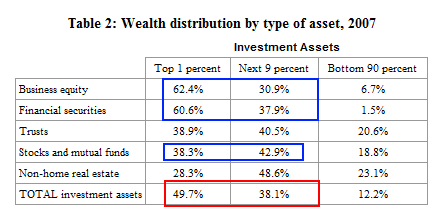
Of investment assets 90 percent of Americans own 12.2 percent. The rest goes to the top 10 percent. Welcome to the new serfdom. The bailouts that went out to the filthy rich were more about protecting their tiny corner of the world than actually making the economy better. That is why it is interesting to see companies fire people and Wall Street cheer for the increase in earnings per share. Good for the few at the expense of the many. Yet the propaganda out of Wall Street and our government is what is good for Wall Street is good for you. Just like that 1.6% inheritance issue, the vast majority of Americans won’t deal with that and their primary concern is simply a job. A job that has provided stagnant wages for a decade while the ultra wealth get richer and richer in a phony form of corporate socialism.
If you break down the data you realize that most Americans don’t have time to speculate in stock markets:
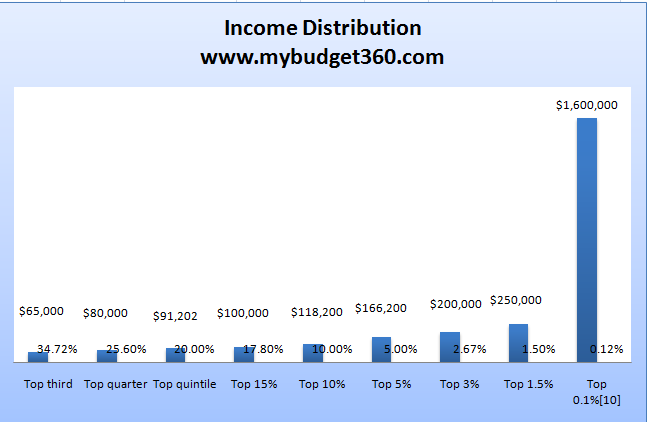
Only 34% of U.S. households make more than $65,000 per year. What is that after taxes? Let us use a state like California for example:
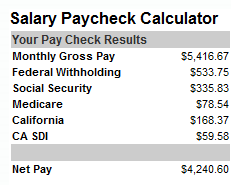
Now if we breakdown this data further you will realize that most of the money is consumed by cost of living necessities, not Wall Street speculation. Just to show this example let us look at a family budget for someone in California making $100,000:
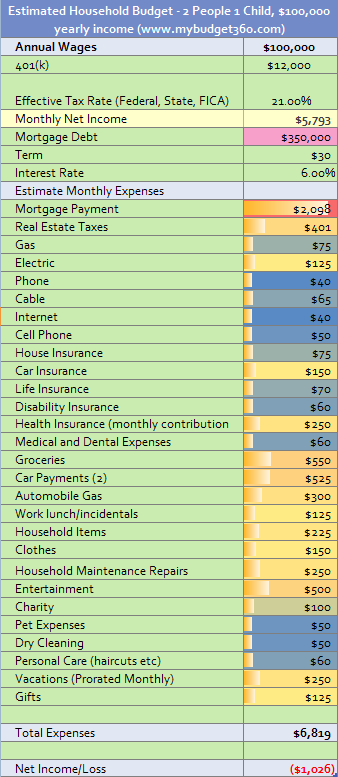
Notice after running the budget we are in the hole for $1,000? That is because of many costs that typical families have. We can debate the merits of where they are spending money but the point is this; are these people really making beaucoup money from the stock market? They are putting away $12,000 a year into their 401k. As we have now found out, 8 percent a year is never guaranteed in the stock market although the corporate powers would like you to believe that so they can have other suckers to unload stocks onto.
“Yet the median household income in the U.S. is $50,000 and not $100,000. They have even less to invest.”They are more concerned on working to have a paycheck to pay for necessities. They are more concerned about paying their house off by the time they retire and hopefully, have a little bit of retirement funds coming in. The sad fact is most Americans rely on Social Security when they retire. All those ads of unlimited golf and daily trips to Tahiti are propaganda of how Wall Street lives and they want to sell you the sizzle, and clearly not the steak. They live their lives paper pushing and sucking the life out of the productive part of our economy. The average American should now realize this since this financial crisis was primarily caused by them. They are now on a massive campaign to blame Americans for this. This is hypocrisy to the next level. Many Americans have paid for their mistake by losing their home through foreclosure. We have 300,000 foreclosure filings a month. Many have taken a hit to their overall stock portfolio (if they have one). Yet the corporate cronies have protected their horrible economy crushing debts at the taxpayer expense. Unlike you, many hold bonds on the companies and not common stock like many Americans. Bondholders have been protected at all costs during this crisis. Goldman Sachs through AIG received 100 cents on the dollar for their horrible bets. The banks have unlimited back stops thanks to taxpayers. This is how the top 1 percent rule the new feudal state.
Welcome to the 2010 serfdom. Time to wake up and restructure the system. Many people are starting to wake up to this massive scam.
original post
The Creature from Jekyll Island: A Second Look at the Federal Reserve -Transcription of Audio Interview, October 28, 2006
G. Edwa rd Griffin
Author
Read the transcript or listen to it in audio format.http://www.financialsensearchive.com/Experts/2006/Griffin.html
Tuesday, November 8, 2011
The more gold the West sells the more China is buying
mineweb.com
NOVEMBER 08, 2011
Author: Lawrence Williams
Posted: Tuesday , 08 Nov 2011
LONDON -
Gold imports into China via Hong Kong are continuing to boom with the total for the quarter to September exceeding the total amount for the whole of 2010. Ever since China loosened its restrictions on precious metals purchases, and indeed started selling the idea of gold and silver investment to the general populace via its state-owned banks (see: China pushes silver and gold investment to the masses), the Asian superpower has rapidly begun to challenge India as the world's largest consumer of gold. Given that it is largely believed that the Chinese state is taking in all its own mined gold (it is currently the world's largest gold producer) into its reserves without declaring the increase, the combined offtake within China of market purchases by the general population plus the amount being taken into its state coffers will soon be getting perhaps close to one third of total world gold output and rising ever faster.
China has always taken the long view and plans for eventualities years in advance. Nothing on the global front is unplanned. This has been seen with the ever increasing number of critical metals and minerals for which China has a virtual monopoly of the global market - rare earths is the most obvious example, but there are a number of other metals where China now provides around 90% of global supplies. Imposition of export quotas ostensibly to protect its own industries then follows, forcing prices up to unprecedented levels, and also forcing companies which require these metals as key parts of specific manufacturing processes to move their plants to China as that is the only way they can guarantee supplies, thus benefiting the Chinese economy as well as helping build employment in the world's most populous country.
Indeed, of the top 20 metals and minerals identified as being at significant supply risk compiled by the British Geological Survey in a recent report production of no less than 11 of them is dominated by China.
So what is China's plan with gold? There almost certainly is one. It can't be a case of tying up global supplies like it has with those critical metals because it doesn't, and can't, control enough of global supply to do that. The logical conclusion is that China is building its total reserves within the country in terms of both its government holdings and as an investment for individuals as it is convinced that the only way for the gold price to go is upwards, and perhaps the only way for the US Dollar and Euro to go is downwards - and ultimately, several years hence, it will move towards making the renminbi either the world's global reserve currency, or a significant part of it and reap the kind of benefits the USA has been able to since the dollar became the de facto global reserve currency.
China is a nation of gold believers, but is prepared to build its reserves gradually over a period of years to towards the purported 8,000 tons plus held by the U.S. Federal Reserve. It has a way to go yet and although it could do so more quickly by utilising its huge $3 trillion surplus to buy gold on the open market it would rather do so surreptitiously and gradually so as not to unduly accelerate the price of gold. This will thus allow its own citizens buying gold as an investment and inflation hedge to benefit and, importantly, allow it to filter down more as the Chinese middle class continues to build.
It has also set up the Pan Asian Gold Exchange (PAGE) which many feel is destined to be much more than that which its name suggests. Not only will it enable buyers to bypass the bullion banks and the LBMA, but it will also provide a path for the international investor to buy renminbi. As the financialsense.com website pointed out ahead of PAGE's opening "PAGE also provides a new way for international investors to own Chinese currency - the Renminbi (RMB). Here's how: The buyers will purchase gold contracts denominated in RMB. They can then hedge out the gold in the dollar-based gold markets. As a result, they effectively own RMB.
"We see here yet another example of multiple Beijing initiatives opening the RMB to world investors. Over time, these innovations will enhance the value of the RMB and create a deeper, more liquid foreign exchange presence for the Chinese currency. PAGE is another internationalization step forward for the RMB in the direction of world reserve currency status.
"The advantages of being the world reserve currency, as well as the responsibilities involved, have not been lost in the Chinese government."
As we said earlier in this article - China has always taken the long view and plans for eventualities years in advance. - The renminbi as the global world currency is probably many years away yet, but the day is getting closer and we would surmise that building its gold reserves is a key part of the long term Chinese plan to exert renminbi hegemony andreplace that of the once-mighty dollar. And its people who are relentlessly hoovering up gold as it is sold off by the West will be double beneficiaries of this long term planning.
Original post
NOVEMBER 08, 2011
Author: Lawrence Williams
Posted: Tuesday , 08 Nov 2011
LONDON -
Gold imports into China via Hong Kong are continuing to boom with the total for the quarter to September exceeding the total amount for the whole of 2010. Ever since China loosened its restrictions on precious metals purchases, and indeed started selling the idea of gold and silver investment to the general populace via its state-owned banks (see: China pushes silver and gold investment to the masses), the Asian superpower has rapidly begun to challenge India as the world's largest consumer of gold. Given that it is largely believed that the Chinese state is taking in all its own mined gold (it is currently the world's largest gold producer) into its reserves without declaring the increase, the combined offtake within China of market purchases by the general population plus the amount being taken into its state coffers will soon be getting perhaps close to one third of total world gold output and rising ever faster.
China has always taken the long view and plans for eventualities years in advance. Nothing on the global front is unplanned. This has been seen with the ever increasing number of critical metals and minerals for which China has a virtual monopoly of the global market - rare earths is the most obvious example, but there are a number of other metals where China now provides around 90% of global supplies. Imposition of export quotas ostensibly to protect its own industries then follows, forcing prices up to unprecedented levels, and also forcing companies which require these metals as key parts of specific manufacturing processes to move their plants to China as that is the only way they can guarantee supplies, thus benefiting the Chinese economy as well as helping build employment in the world's most populous country.
Indeed, of the top 20 metals and minerals identified as being at significant supply risk compiled by the British Geological Survey in a recent report production of no less than 11 of them is dominated by China.
So what is China's plan with gold? There almost certainly is one. It can't be a case of tying up global supplies like it has with those critical metals because it doesn't, and can't, control enough of global supply to do that. The logical conclusion is that China is building its total reserves within the country in terms of both its government holdings and as an investment for individuals as it is convinced that the only way for the gold price to go is upwards, and perhaps the only way for the US Dollar and Euro to go is downwards - and ultimately, several years hence, it will move towards making the renminbi either the world's global reserve currency, or a significant part of it and reap the kind of benefits the USA has been able to since the dollar became the de facto global reserve currency.
China is a nation of gold believers, but is prepared to build its reserves gradually over a period of years to towards the purported 8,000 tons plus held by the U.S. Federal Reserve. It has a way to go yet and although it could do so more quickly by utilising its huge $3 trillion surplus to buy gold on the open market it would rather do so surreptitiously and gradually so as not to unduly accelerate the price of gold. This will thus allow its own citizens buying gold as an investment and inflation hedge to benefit and, importantly, allow it to filter down more as the Chinese middle class continues to build.
It has also set up the Pan Asian Gold Exchange (PAGE) which many feel is destined to be much more than that which its name suggests. Not only will it enable buyers to bypass the bullion banks and the LBMA, but it will also provide a path for the international investor to buy renminbi. As the financialsense.com website pointed out ahead of PAGE's opening "PAGE also provides a new way for international investors to own Chinese currency - the Renminbi (RMB). Here's how: The buyers will purchase gold contracts denominated in RMB. They can then hedge out the gold in the dollar-based gold markets. As a result, they effectively own RMB.
"We see here yet another example of multiple Beijing initiatives opening the RMB to world investors. Over time, these innovations will enhance the value of the RMB and create a deeper, more liquid foreign exchange presence for the Chinese currency. PAGE is another internationalization step forward for the RMB in the direction of world reserve currency status.
"The advantages of being the world reserve currency, as well as the responsibilities involved, have not been lost in the Chinese government."
As we said earlier in this article - China has always taken the long view and plans for eventualities years in advance. - The renminbi as the global world currency is probably many years away yet, but the day is getting closer and we would surmise that building its gold reserves is a key part of the long term Chinese plan to exert renminbi hegemony andreplace that of the once-mighty dollar. And its people who are relentlessly hoovering up gold as it is sold off by the West will be double beneficiaries of this long term planning.
Original post
Saturday, November 5, 2011
Fall Of The House Of Money: Artemis Capital On How €entral Banking Took Over Capital Markets... And The World
Submitted by Tyler Durden on 11/04/2011 15:36 -0400 zerohedge.com
One of the long-term recurring themes both here and in other more objective media, has been the encroaching domination of the central planning regime, or monetary authorities, read central banks, in the domain of capital markets and overall broad sovereignty, to the point where there is neither technical nor fundamental analysis left, but merely the question of where is the next batch of excess liquidity going to come from. Welcome to the death throes of the fiat system. Artemis Capital has released an extended must read presentation that summarizes just how global changes in trade, currency exchange, global monetary excess liquidity in recent decades, and especially in the coming future, will increasingly determine and define risk, and more troubling, the centuries old anarchism of state sovereignty. Anarchism, because as Europe has demonstrated so very well, in the current world the only real actors are the central banks. And with each passing day they become ever more powerful players in the global capital markets arena, as confirmed by correlations that rise every higher, approaching 1.000 across all asset classes. Anyone wondering why the only fulcrum variable for the future of risk will be FX exchange rates, and why any and all wars in the future will be primarily in binary "currency" format, we urge a careful reading of the attached slideshow by Artemis Capital titled "Fall of the House Of Money: Changes in Global Trade and Currency Exchange."
None of this will come as a surprise to regular readers, but some of the concepts bear repeating.
Artemis' Chris Cole starts with the premise of "World War €urrency"
Countries are artificially devaluing their currencies to generate competitive trade advantages or to finance deficits
United States
* Ultra-loose monetary policy (ZIRP & Quantitative Easing)
* Massive government deficits and high debt levels
* Unsustainable fiscal spending and entitlements
Japan
* ZIRP and debt-GDP-ratios above 200%+
* Japanese government intervened in foreign exchange markets for the 4th time in over a year (selling yen and buying dollars & euros)
China
* Yuan is pegged to the dollar and estimated to be as much as 40% undervalued against the US dollar
* China keeps buying dollars and “printing” Yuan to maintain this peg
Switzerland
* Swiss Franc was a popular safe haven appreciating +28% against the Euro and +50% against the dollar since 2003
* SNB devalued Franc in September pegging it at 1.20x to the Euro
Brazil
* Central bank cuts interest rates twice in the last quarter despite highest inflation in six years
At its core, the primary source of tension, volatility and margina price influence is the relationship between the developed (debtor) and emerging (Creditor) nation.
What this underlying dynamic results in is a world in which asset prices are driven not by economic fundamentals but by the "Carry Trade" - i.e. who has the most and cheapest capital/liquidity.
The liquidity generated by the debtor nations, and which drives the above Risk ___ dynamics, has had another ominous side-effect: sending all correlations to all time record highs.
Doubt the carry trade is the stock market? Don't.
Naturally, the next point of debat is an observation of the biggest transgressor of all: the United States, and its central bank, whose sole purpose for its existence, has been to slowly devalue the dollar thus creating stealth inflation, and inflating the debt which not only in America, but across the entire developed world is now at an all time high. Alas, with ZIRP in place, and negative rates impossible, the only other option is to print ever more.
Nothing new there.
Yet the question remains: can currency devaluation be the basis of economic growth? The answer: it can create the illusion of economic growth... and that's it.
Even more stark is the following chart: it shows the S&P adjusted for the dollar's value destruction: seen this way the S&P is comparable to levels seen back in 1997! But because nobody considers the fact that all stock profits are paid out in dollars, and the dollar has lost so much purchasing power ever since the great moderation, instead gauging everything in nominal values, it is obvious that the Fed's plan continues to work.
So what is the conclusion:
1. Global currency regime will face significant changes in the ensuing decade
2. Self-reinforcing cycle between Debtor-Developed and Emerging-Creditor nations likely to unravel – perhaps violently
3. European crisis may tip us into a second global recession
4. Global policy makers are out of stimulus options
5. Dollar hegemony may be challenged in the future
And some advice from Artemis:
1. Prepare your business for the potential of a second global recession
2. USD is historically strong when the economy is weak – watch for reversal
3. Evaluate portfolio returns against a global basket of currencies and commodities
4. Diversify exposure during periods of dollar strength and deleveraging :
1. Nations with healthy finances and commodity driven economies (e.g. Canadian Dollar, Norwegian Krone, Australian Dollar)
2. Tangible assets like real estate and metals (but not on leverage)
3. Alternative asset classes (e.g. volatility and managed futures)
Full presentation:
Art Em is Capital CurrencyCSCM NOV2011 Final
One of the long-term recurring themes both here and in other more objective media, has been the encroaching domination of the central planning regime, or monetary authorities, read central banks, in the domain of capital markets and overall broad sovereignty, to the point where there is neither technical nor fundamental analysis left, but merely the question of where is the next batch of excess liquidity going to come from. Welcome to the death throes of the fiat system. Artemis Capital has released an extended must read presentation that summarizes just how global changes in trade, currency exchange, global monetary excess liquidity in recent decades, and especially in the coming future, will increasingly determine and define risk, and more troubling, the centuries old anarchism of state sovereignty. Anarchism, because as Europe has demonstrated so very well, in the current world the only real actors are the central banks. And with each passing day they become ever more powerful players in the global capital markets arena, as confirmed by correlations that rise every higher, approaching 1.000 across all asset classes. Anyone wondering why the only fulcrum variable for the future of risk will be FX exchange rates, and why any and all wars in the future will be primarily in binary "currency" format, we urge a careful reading of the attached slideshow by Artemis Capital titled "Fall of the House Of Money: Changes in Global Trade and Currency Exchange."
None of this will come as a surprise to regular readers, but some of the concepts bear repeating.
Artemis' Chris Cole starts with the premise of "World War €urrency"
Countries are artificially devaluing their currencies to generate competitive trade advantages or to finance deficits
United States
* Ultra-loose monetary policy (ZIRP & Quantitative Easing)
* Massive government deficits and high debt levels
* Unsustainable fiscal spending and entitlements
Japan
* ZIRP and debt-GDP-ratios above 200%+
* Japanese government intervened in foreign exchange markets for the 4th time in over a year (selling yen and buying dollars & euros)
China
* Yuan is pegged to the dollar and estimated to be as much as 40% undervalued against the US dollar
* China keeps buying dollars and “printing” Yuan to maintain this peg
Switzerland
* Swiss Franc was a popular safe haven appreciating +28% against the Euro and +50% against the dollar since 2003
* SNB devalued Franc in September pegging it at 1.20x to the Euro
Brazil
* Central bank cuts interest rates twice in the last quarter despite highest inflation in six years
At its core, the primary source of tension, volatility and margina price influence is the relationship between the developed (debtor) and emerging (Creditor) nation.
What this underlying dynamic results in is a world in which asset prices are driven not by economic fundamentals but by the "Carry Trade" - i.e. who has the most and cheapest capital/liquidity.
The liquidity generated by the debtor nations, and which drives the above Risk ___ dynamics, has had another ominous side-effect: sending all correlations to all time record highs.
Doubt the carry trade is the stock market? Don't.
Naturally, the next point of debat is an observation of the biggest transgressor of all: the United States, and its central bank, whose sole purpose for its existence, has been to slowly devalue the dollar thus creating stealth inflation, and inflating the debt which not only in America, but across the entire developed world is now at an all time high. Alas, with ZIRP in place, and negative rates impossible, the only other option is to print ever more.
Nothing new there.
Yet the question remains: can currency devaluation be the basis of economic growth? The answer: it can create the illusion of economic growth... and that's it.
Even more stark is the following chart: it shows the S&P adjusted for the dollar's value destruction: seen this way the S&P is comparable to levels seen back in 1997! But because nobody considers the fact that all stock profits are paid out in dollars, and the dollar has lost so much purchasing power ever since the great moderation, instead gauging everything in nominal values, it is obvious that the Fed's plan continues to work.
So what is the conclusion:
1. Global currency regime will face significant changes in the ensuing decade
2. Self-reinforcing cycle between Debtor-Developed and Emerging-Creditor nations likely to unravel – perhaps violently
3. European crisis may tip us into a second global recession
4. Global policy makers are out of stimulus options
5. Dollar hegemony may be challenged in the future
And some advice from Artemis:
1. Prepare your business for the potential of a second global recession
2. USD is historically strong when the economy is weak – watch for reversal
3. Evaluate portfolio returns against a global basket of currencies and commodities
4. Diversify exposure during periods of dollar strength and deleveraging :
1. Nations with healthy finances and commodity driven economies (e.g. Canadian Dollar, Norwegian Krone, Australian Dollar)
2. Tangible assets like real estate and metals (but not on leverage)
3. Alternative asset classes (e.g. volatility and managed futures)
Full presentation:
Art Em is Capital CurrencyCSCM NOV2011 Final
china
by Larry Laborde - SilverTrading.net
Last week the LaBorde family was down in South Louisiana at the New Orleans Investment Conference. After attending a presentation on China by the very passionate Dr. Stephen Leeb, author of Red Alert: How China's Growing Prosperity Threatens the American Way of Life; it became more apparent that China is becoming an economic super predator. His explanation of the current situation seemed comparable to a boxing match. In one corner there stands a boxer who does not know he is in the ring, but he has a very strong reputation. In the other corner stands a boxer who is a little lighter but has been training hard. To tilt the scales farther, the boxer that has been training has also decided to hedge his bets by purchasing all of the boxing shoes, gloves, trainers and ring time while the other boxer was not even paying attention. The United States is not necessarily done for, but it is time for us to at least realize that we are in a fight and act accordingly.
As a long time chess player, Dr. Stephen Leeb expressed that he is downright scared of the way that our opponent is systematically playing an enviable game of strategy and yet we haven’t even started to acknowledge that we are engaged in a competition that threatens our entire way of life. His argument was focused around resource acquisition for global economic control. On the surface his reasoning sounded much like many of the ideals that we have previously heard. However, as he continued to speak his argument invoked a mixture of respect for the efficiency of the Chinese machine and shock at how far behind we may be. Some of the high points of his presentation are listed below:
People: Besides having a massive workforce and graduating more engineers each year than we have working in this country, China operates on more of a meritocracy, or by rewarding the merit of individuals, than the US does. An example of this can be seen in that one of the premier female chess players in the world right now is a young Chinese adolescent that was pulled out of the fields when it was recognized that she had an aptitude for strategy as a young girl. If she continues on her current trajectory, Dr. Leeb suspects she will be playing the men soon. It is this mindset of making efforts to elevate their best, brightest and hardest working that permeates much of their society. In business there are more Chinese billionaires being made each year than anywhere else in the world. In government they have repeatedly been cultivating this kind of talent as well and Dr. Leeb believes that this talent is playing the resource war very well.
Copper: China is spending dollar amounts of a similar magnitude in Afghanistan as the United States, the difference is that they are mining copper while we are creating the world’s best distraction for them to do so. The reason that getting a leg up on the world’s copper supply is exceptionally scary is that copper is at the root of many or the world’s future “green” technologies besides being the backbone of many of the world’s existing technologies.
Rare Earth metals: “Rare earth metals” are the bedrock of the future of all long-life, lightweight batteries. Over the years China has developed it’s mines in Mongolia and it’s processing plants to the point that they now produce 97% of the world’s supply. This probably needs no explanation as the world moves into electric cars and even a couple electric planes. Clean energy is a global concern and the efficient storage of this energy is a big concern as well and will only grow in importance over the coming years. China has stopped exporting rare earth metals in raw form and instead will only sell them as components in finished products shutting out everyone else around the world. This gives them a tremendous leg up on all finished products related to rare earth metals, such as batteries and permanent magnet motors, a core component of most high-efficiency electric generators.
Solar Energy: “First Solar” is the name of the U.S. based company that was the second largest producer of solar panels in the world in 2010. Last week First Solar took a 25% bath and the top of the blame list can be summarized with a quote from an article in Forbes from last week, “First Solar did not provide any details but the handwriting was on the wall. Recently, there has been considerable anecdotal evidence that First Solar is no longer competitive with Chinese imports.” First Solar was listed number one in the top 25 fastest growing companies in America in 2011. What could bring an innovative giant like this down? According to the article, a $30 billion dollar helping hand of the Chinese government to it’s entire solar sector making US production not financially feasible at this time. With that kind of help there is just not much a company, or country, can do to prevent China from getting a complete and total lock on the solar industry—a potential lynch pin industry in the forward motion of clean energy.
The Oil Game: Two words, Petro China. Petro China is the traded name of the Chinese National Petroleum Corporation that announced its plans to go public in November of 2007. The company tripled in value once public, was the most valuable publicly traded company on the exchange as of September 28th of 2011, and was the first company to reach a trillion dollar market capitalization. Though the Chinese are gearing up for futuristic energy sources they seem to have a firm understanding that petrol based energy will be ushering us and them into the world of green energy and will be critical in bridging us there.
Gold: What is China doing with gold you ask? They, along with Russia, appear to be slowly but surely attempting to accumulate enough to one day back their currency with it. They are also encouraging their citizens to accumulate gold by opening a new metals exchange and granting tax exemptions. If you have slept through everything else written in this article, this single point should be enough to tip you off that: 1. The US dollar is potentially in more trouble than indicated by the press and 2. If metals become popular in a country with a population of 1.33 billion savers there may be a boost in gold’s overall demand; this could potentially resemble the craziness associated with the Tickle-Me-Elmo doll during the ‘96 Christmas season.
To quote Dr. Leeb, “We are at war and we don’t even know it! Wake up, America!”
Of all the points listed above one is of particular concern to us—it is that China is poised to change the global pricing of gold. We can buy and be holders of Petro China, rare earth metals, copper and stocks in Chinese solar companies; but we sell gold and understand it best. As a result of hearing Dr. Leeb’s impassioned views we feel that both gold and silver are positioned very well for motion in a positive direction. It is our position that gold and silver will be rising significantly over the next year, so if you have any questions about acquisition please feel free to give us a call.
Last week the LaBorde family was down in South Louisiana at the New Orleans Investment Conference. After attending a presentation on China by the very passionate Dr. Stephen Leeb, author of Red Alert: How China's Growing Prosperity Threatens the American Way of Life; it became more apparent that China is becoming an economic super predator. His explanation of the current situation seemed comparable to a boxing match. In one corner there stands a boxer who does not know he is in the ring, but he has a very strong reputation. In the other corner stands a boxer who is a little lighter but has been training hard. To tilt the scales farther, the boxer that has been training has also decided to hedge his bets by purchasing all of the boxing shoes, gloves, trainers and ring time while the other boxer was not even paying attention. The United States is not necessarily done for, but it is time for us to at least realize that we are in a fight and act accordingly.
As a long time chess player, Dr. Stephen Leeb expressed that he is downright scared of the way that our opponent is systematically playing an enviable game of strategy and yet we haven’t even started to acknowledge that we are engaged in a competition that threatens our entire way of life. His argument was focused around resource acquisition for global economic control. On the surface his reasoning sounded much like many of the ideals that we have previously heard. However, as he continued to speak his argument invoked a mixture of respect for the efficiency of the Chinese machine and shock at how far behind we may be. Some of the high points of his presentation are listed below:
People: Besides having a massive workforce and graduating more engineers each year than we have working in this country, China operates on more of a meritocracy, or by rewarding the merit of individuals, than the US does. An example of this can be seen in that one of the premier female chess players in the world right now is a young Chinese adolescent that was pulled out of the fields when it was recognized that she had an aptitude for strategy as a young girl. If she continues on her current trajectory, Dr. Leeb suspects she will be playing the men soon. It is this mindset of making efforts to elevate their best, brightest and hardest working that permeates much of their society. In business there are more Chinese billionaires being made each year than anywhere else in the world. In government they have repeatedly been cultivating this kind of talent as well and Dr. Leeb believes that this talent is playing the resource war very well.
Copper: China is spending dollar amounts of a similar magnitude in Afghanistan as the United States, the difference is that they are mining copper while we are creating the world’s best distraction for them to do so. The reason that getting a leg up on the world’s copper supply is exceptionally scary is that copper is at the root of many or the world’s future “green” technologies besides being the backbone of many of the world’s existing technologies.
Rare Earth metals: “Rare earth metals” are the bedrock of the future of all long-life, lightweight batteries. Over the years China has developed it’s mines in Mongolia and it’s processing plants to the point that they now produce 97% of the world’s supply. This probably needs no explanation as the world moves into electric cars and even a couple electric planes. Clean energy is a global concern and the efficient storage of this energy is a big concern as well and will only grow in importance over the coming years. China has stopped exporting rare earth metals in raw form and instead will only sell them as components in finished products shutting out everyone else around the world. This gives them a tremendous leg up on all finished products related to rare earth metals, such as batteries and permanent magnet motors, a core component of most high-efficiency electric generators.
Solar Energy: “First Solar” is the name of the U.S. based company that was the second largest producer of solar panels in the world in 2010. Last week First Solar took a 25% bath and the top of the blame list can be summarized with a quote from an article in Forbes from last week, “First Solar did not provide any details but the handwriting was on the wall. Recently, there has been considerable anecdotal evidence that First Solar is no longer competitive with Chinese imports.” First Solar was listed number one in the top 25 fastest growing companies in America in 2011. What could bring an innovative giant like this down? According to the article, a $30 billion dollar helping hand of the Chinese government to it’s entire solar sector making US production not financially feasible at this time. With that kind of help there is just not much a company, or country, can do to prevent China from getting a complete and total lock on the solar industry—a potential lynch pin industry in the forward motion of clean energy.
The Oil Game: Two words, Petro China. Petro China is the traded name of the Chinese National Petroleum Corporation that announced its plans to go public in November of 2007. The company tripled in value once public, was the most valuable publicly traded company on the exchange as of September 28th of 2011, and was the first company to reach a trillion dollar market capitalization. Though the Chinese are gearing up for futuristic energy sources they seem to have a firm understanding that petrol based energy will be ushering us and them into the world of green energy and will be critical in bridging us there.
Gold: What is China doing with gold you ask? They, along with Russia, appear to be slowly but surely attempting to accumulate enough to one day back their currency with it. They are also encouraging their citizens to accumulate gold by opening a new metals exchange and granting tax exemptions. If you have slept through everything else written in this article, this single point should be enough to tip you off that: 1. The US dollar is potentially in more trouble than indicated by the press and 2. If metals become popular in a country with a population of 1.33 billion savers there may be a boost in gold’s overall demand; this could potentially resemble the craziness associated with the Tickle-Me-Elmo doll during the ‘96 Christmas season.
To quote Dr. Leeb, “We are at war and we don’t even know it! Wake up, America!”
Of all the points listed above one is of particular concern to us—it is that China is poised to change the global pricing of gold. We can buy and be holders of Petro China, rare earth metals, copper and stocks in Chinese solar companies; but we sell gold and understand it best. As a result of hearing Dr. Leeb’s impassioned views we feel that both gold and silver are positioned very well for motion in a positive direction. It is our position that gold and silver will be rising significantly over the next year, so if you have any questions about acquisition please feel free to give us a call.
Thursday, November 3, 2011
Australia, France… Wherever You Are, Demand For Physical Gold And Silver Is Soaring
WHAT OTHERS ARE THINKING
Money Morning Australia’s Alex Cowie recently saw at first hand the clamour for gold and silver in Europe.
“I was strolling through the main square of a small French town a few days ago. It was about the same size as Tamworth – around 40,000 people. It was in the middle of nowhere. And would you believe next to the boulangerie was a shop selling gold and silver – and nothing else.
No foreign exchange. No travellers cheques. Just precious metals. So naturally I popped in to see how business was doing.
The shop seller told me the same thing I’ve heard in Australia (and other parts of the world). Bullion dealers can’t keep up with demand. According to her, sellers are buying increasingly large amounts of gold – particularly on the dips. And she can hardly get her hands on any silver to sell.
Remember – this wasn’t in the big smoke of Paris. It was a fairly small town. And I think it just goes to show the growing demand for physical gold and silver is global.
It would certainly back up the Perth Mint’s recent report that demand is …currently running at unprecedented levels and we have been inundated by high levels of web and telephone traffic from clients all around the world.”
Stephen Ward
The Perth Mint Blog
Money Morning Australia’s Alex Cowie recently saw at first hand the clamour for gold and silver in Europe.
“I was strolling through the main square of a small French town a few days ago. It was about the same size as Tamworth – around 40,000 people. It was in the middle of nowhere. And would you believe next to the boulangerie was a shop selling gold and silver – and nothing else.
No foreign exchange. No travellers cheques. Just precious metals. So naturally I popped in to see how business was doing.
The shop seller told me the same thing I’ve heard in Australia (and other parts of the world). Bullion dealers can’t keep up with demand. According to her, sellers are buying increasingly large amounts of gold – particularly on the dips. And she can hardly get her hands on any silver to sell.
Remember – this wasn’t in the big smoke of Paris. It was a fairly small town. And I think it just goes to show the growing demand for physical gold and silver is global.
It would certainly back up the Perth Mint’s recent report that demand is …currently running at unprecedented levels and we have been inundated by high levels of web and telephone traffic from clients all around the world.”
Stephen Ward
The Perth Mint Blog
Subscribe to:
Posts (Atom)