'Representation of public figures is something we try to avoid'
Posted: November 29, 2011
7:37 pm Eastern
By Jerome R. Corsi
© 2011 WND
Two television spots developed by a national investment firm specializing in U.S. gold and silver coins have been rejected by major television networks, including the Fox News Channel and the Fox Business Network, for apparently political reasons.
The ads by Phoenix-based Swiss America Trading Corp., a WND advertiser, feature President Obama and Federal Reserve Chairman Ben Bernanke as animated characters engaging in the potentially inflationary policy of printing paper money with abandon to stimulate the struggling economy.
Singer Pat Boone, a spokesman for Swiss America for more than 15 years, appears in the commercials as an animated announcer who concludes that investing in gold is a prudent strategy to diversify a portfolio in inflationary times.
"The Creature from Jekyll Island: A Second Look at the Federal Reserve"
Swiss America CEO Craig Smith said the intent of the ads was not to make a political statement.
The goal, he said, "was to take what we thought was a humorous approach to a timely and important economic topic in order to advertise our company and promote a new book we've recently published."
Along with Fox News and Fox Business, the two commercials have been rejected by NBC, MSNBC, CNBC, ABC, CBS, CNN/HLN and the Discovery Channel.
Comcast, in rejecting the spot, told Swiss America that it "does not meet our standards on public symbol."
Comcast's Public Symbol Policy specifies that the "use of the name or likeness of the President of the United States and/or the Presidential Seal for endorsing commercial purposes must be authorized by the White House."
Fox News said the "representation of public figures is something we try to avoid."
CNN/HLN told Swiss America the commercials were "not appropriate for the current political landscape."
"The networks' reaction shocked me," Smith said. "It's a threat to First Amendment rights when a commercial message is rejected not because it is inaccurate or misleading, but because it makes what is perceived to be a political statement the networks want to avoid."
Smith told WND he was concerned that the networks were protecting Obama and Bernanke.
"All we are saying in these two commercials is what dozens of responsible professional economists are saying every day," Smith said. "Gold investment as a responsible diversification strategy when governments printing of fiat currencies with abandon risk unleashing inflationary principles."
Only Google TV accepted the commercials, for broadcast on the DISH Network and Direct TV satellite networks.
Google TV has planned a test in which the two ads will be broadcast 1,132 times on the DISH Network and Direct TV from Dec. 5, 2011, through Jan. 12, 2012.
read the rest here..
goldsilver.com

Tuesday, December 6, 2011

Monday, November 28, 2011
Chavez calls in troops to move first of 15,000 gold bars to Caracas central bank
Latin American Herald Tribune reports Venezuela’s first shipment of 160 – 180 tonnes of gold held abroad was received at Maiquetia International Airport outside Caracas on Friday night.
In operation that also involved tanks and aircraft, the first of some 15,000 standard 400-ounce bars wrapped in black plastic inside a caravan of armoured vehicles escorted by 500 soldiers then made its way to the bank’s headquarters downtown. President Hugo Chavez announced in August that the South American country plans to repatriate its gold reserves held by banks in England, the US, Canada and France. The Central Bank of Venezuela already holds 154 tons of bullion domestically.
Latin American Herald Tribune reports aircraft and tanks were aslo involved in safeguarding the shipment according to General Silva of the country’s strategic operational command. “Each box of gold weighs 500 kilograms and is worth about $30 million,” president of Venezuela’s central bank, Nelson Merentes told gathered crowds. The country held 211 tons – nearly $11 billion worth – of its 365 tonnes of gold reserves abroad. Venezuela has the largest gold reserves in South America.
CTV reported in August Venezuela would need to transport the gold in several trips, traders said, since the high value of gold means it would be impossible to insure a single aircraft carrying 211 tonnes. It could take about 40 shipments to move the gold back to Caracas, traders estimated.
While billions of dollars worth of gold is traded every day, only a tiny proportion of it moves from vaults in London, New York and Zurich. Read more on the logistics of moving such vast amounts of gold.
http://www.mining.com/2011/11/27/chavez-calls-in-troops-to-move-first-of-15000-gold-bars-to-caracas-central-bank/
In operation that also involved tanks and aircraft, the first of some 15,000 standard 400-ounce bars wrapped in black plastic inside a caravan of armoured vehicles escorted by 500 soldiers then made its way to the bank’s headquarters downtown. President Hugo Chavez announced in August that the South American country plans to repatriate its gold reserves held by banks in England, the US, Canada and France. The Central Bank of Venezuela already holds 154 tons of bullion domestically.
Latin American Herald Tribune reports aircraft and tanks were aslo involved in safeguarding the shipment according to General Silva of the country’s strategic operational command. “Each box of gold weighs 500 kilograms and is worth about $30 million,” president of Venezuela’s central bank, Nelson Merentes told gathered crowds. The country held 211 tons – nearly $11 billion worth – of its 365 tonnes of gold reserves abroad. Venezuela has the largest gold reserves in South America.
CTV reported in August Venezuela would need to transport the gold in several trips, traders said, since the high value of gold means it would be impossible to insure a single aircraft carrying 211 tonnes. It could take about 40 shipments to move the gold back to Caracas, traders estimated.
While billions of dollars worth of gold is traded every day, only a tiny proportion of it moves from vaults in London, New York and Zurich. Read more on the logistics of moving such vast amounts of gold.
http://www.mining.com/2011/11/27/chavez-calls-in-troops-to-move-first-of-15000-gold-bars-to-caracas-central-bank/
Saturday, November 19, 2011
Top 1 Percent Control 42 Percent of Financial Wealth in the U.S. – How Average Americans are Lured into Debt Servitude by Promises of Mega Wealth.
Many Americans are still struggling at the depths of this recession. We have 37 million Americans on food stamps and many wait until midnight of the last day of the month so checks can clear to buy food at Wal-Mart. Do you think these people are starring at the stock market? The overall data is much worse:
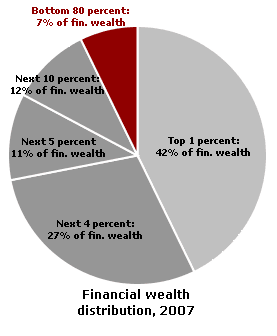
Source: William Domhoff
If we break the data down further we will find that 93 percent of all financial wealth is controlled by the top 10 percent of the country. That is why these people are cheering their one cent share increase while layoffs keep on improving the bottom line. But what bottom line are we talking about here? The Wall Street crowd would like you to believe that all is now good that the stock market has rallied 60+ percent. Of course they are happy because they control most of this wealth. Yet the typical American still has negative views on the economy because they actually have to work to earn a living:
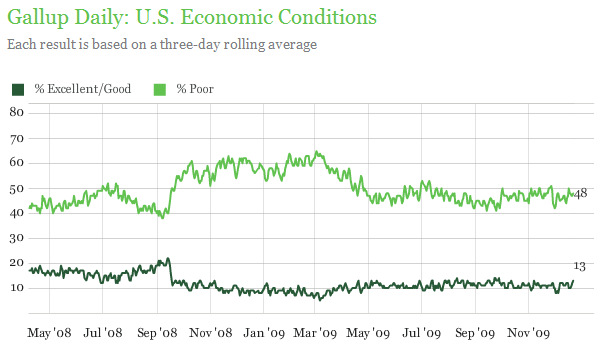
The above daily poll asks Americans about their view on the health of the economy. Only 13 percent believe the economy is good or excellent. Funny how that correlates with the top 10 percent who control 93 percent of wealth. Many Americans were sold the illusion of the bubble. They were sold on the idea that their homes were worth so much more than they really were. And many used this phony wealth effect to go out and spend beyond their means. They started spending as if they were part of this elite 10 percent crowd. But once the tide rolled out, it was clear they were not. And the horribly built bailouts demonstrate who is controlling our political system. This was not the rule of a capitalist system but a corporate run government.
Just think about the bailouts and which companies were saved. We ended up bailing out the worst performing and troubled companies thus keeping alive companies that should have completely failed. Did we bail out Google? Proctor and Gamble? Of course not. These companies actually produce something that people want. Banks and especially the Wall Street kind merely keep that 42 percent happy by making sure their stock values stay high so they can keep on making money while the average Americans is sold up the river.
Yet many were brought into the easy money fold by going into massive amounts of debt. And who has most of the debt? That is right, the average American:
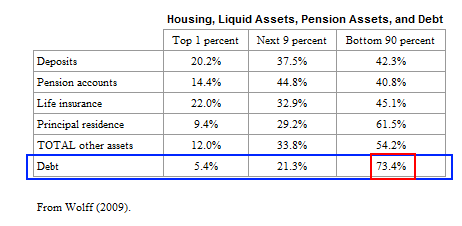
The bottom 90 percent have been saddled with 73 percent of all debt. In other words much of their so-called wealth is connected to debt. Debt is slavery for many especially with egregious credit card companies taking people out with absurd credit card tricks and scams. Yet the corporate propaganda machine is strong and mighty. Have you ever received an inheritance? A large one? Probably not because only 1.6% of all Americans receive an inheritance larger than $100,000. If this is the case, why in the world do politicians worry so much about the tax impacts of this? Because they want to keep the corporatocracy alive and well so their spawn can get a piece of their pie. They give the illusion to average Americans that if you only work hard enough you too can join this elusive club of cronies. The data shows otherwise.
But if we start looking at investment assets, the true wealth in the country, we start realizing why Wall Street is all giddy about the recent stock market government induced rally:
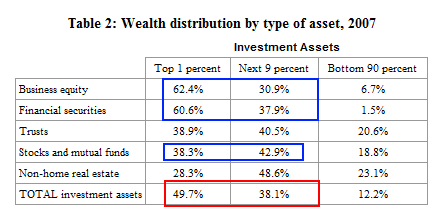
Of investment assets 90 percent of Americans own 12.2 percent. The rest goes to the top 10 percent. Welcome to the new serfdom. The bailouts that went out to the filthy rich were more about protecting their tiny corner of the world than actually making the economy better. That is why it is interesting to see companies fire people and Wall Street cheer for the increase in earnings per share. Good for the few at the expense of the many. Yet the propaganda out of Wall Street and our government is what is good for Wall Street is good for you. Just like that 1.6% inheritance issue, the vast majority of Americans won’t deal with that and their primary concern is simply a job. A job that has provided stagnant wages for a decade while the ultra wealth get richer and richer in a phony form of corporate socialism.
If you break down the data you realize that most Americans don’t have time to speculate in stock markets:
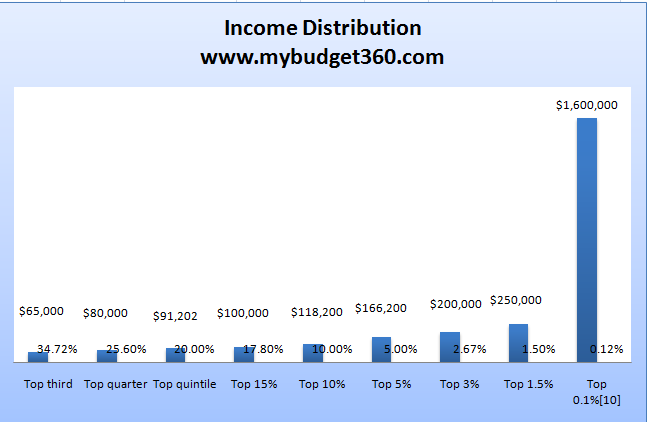
Only 34% of U.S. households make more than $65,000 per year. What is that after taxes? Let us use a state like California for example:
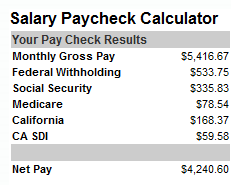
Now if we breakdown this data further you will realize that most of the money is consumed by cost of living necessities, not Wall Street speculation. Just to show this example let us look at a family budget for someone in California making $100,000:
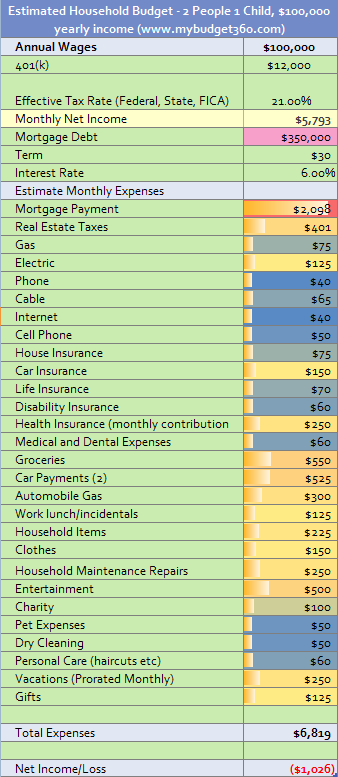
Notice after running the budget we are in the hole for $1,000? That is because of many costs that typical families have. We can debate the merits of where they are spending money but the point is this; are these people really making beaucoup money from the stock market? They are putting away $12,000 a year into their 401k. As we have now found out, 8 percent a year is never guaranteed in the stock market although the corporate powers would like you to believe that so they can have other suckers to unload stocks onto.
“Yet the median household income in the U.S. is $50,000 and not $100,000. They have even less to invest.”They are more concerned on working to have a paycheck to pay for necessities. They are more concerned about paying their house off by the time they retire and hopefully, have a little bit of retirement funds coming in. The sad fact is most Americans rely on Social Security when they retire. All those ads of unlimited golf and daily trips to Tahiti are propaganda of how Wall Street lives and they want to sell you the sizzle, and clearly not the steak. They live their lives paper pushing and sucking the life out of the productive part of our economy. The average American should now realize this since this financial crisis was primarily caused by them. They are now on a massive campaign to blame Americans for this. This is hypocrisy to the next level. Many Americans have paid for their mistake by losing their home through foreclosure. We have 300,000 foreclosure filings a month. Many have taken a hit to their overall stock portfolio (if they have one). Yet the corporate cronies have protected their horrible economy crushing debts at the taxpayer expense. Unlike you, many hold bonds on the companies and not common stock like many Americans. Bondholders have been protected at all costs during this crisis. Goldman Sachs through AIG received 100 cents on the dollar for their horrible bets. The banks have unlimited back stops thanks to taxpayers. This is how the top 1 percent rule the new feudal state.
Welcome to the 2010 serfdom. Time to wake up and restructure the system. Many people are starting to wake up to this massive scam.
original post
The Creature from Jekyll Island: A Second Look at the Federal Reserve -Transcription of Audio Interview, October 28, 2006
G. Edwa rd Griffin
Author
Read the transcript or listen to it in audio format.http://www.financialsensearchive.com/Experts/2006/Griffin.html
Tuesday, November 8, 2011
The more gold the West sells the more China is buying
mineweb.com
NOVEMBER 08, 2011
Author: Lawrence Williams
Posted: Tuesday , 08 Nov 2011
LONDON -
Gold imports into China via Hong Kong are continuing to boom with the total for the quarter to September exceeding the total amount for the whole of 2010. Ever since China loosened its restrictions on precious metals purchases, and indeed started selling the idea of gold and silver investment to the general populace via its state-owned banks (see: China pushes silver and gold investment to the masses), the Asian superpower has rapidly begun to challenge India as the world's largest consumer of gold. Given that it is largely believed that the Chinese state is taking in all its own mined gold (it is currently the world's largest gold producer) into its reserves without declaring the increase, the combined offtake within China of market purchases by the general population plus the amount being taken into its state coffers will soon be getting perhaps close to one third of total world gold output and rising ever faster.
China has always taken the long view and plans for eventualities years in advance. Nothing on the global front is unplanned. This has been seen with the ever increasing number of critical metals and minerals for which China has a virtual monopoly of the global market - rare earths is the most obvious example, but there are a number of other metals where China now provides around 90% of global supplies. Imposition of export quotas ostensibly to protect its own industries then follows, forcing prices up to unprecedented levels, and also forcing companies which require these metals as key parts of specific manufacturing processes to move their plants to China as that is the only way they can guarantee supplies, thus benefiting the Chinese economy as well as helping build employment in the world's most populous country.
Indeed, of the top 20 metals and minerals identified as being at significant supply risk compiled by the British Geological Survey in a recent report production of no less than 11 of them is dominated by China.
So what is China's plan with gold? There almost certainly is one. It can't be a case of tying up global supplies like it has with those critical metals because it doesn't, and can't, control enough of global supply to do that. The logical conclusion is that China is building its total reserves within the country in terms of both its government holdings and as an investment for individuals as it is convinced that the only way for the gold price to go is upwards, and perhaps the only way for the US Dollar and Euro to go is downwards - and ultimately, several years hence, it will move towards making the renminbi either the world's global reserve currency, or a significant part of it and reap the kind of benefits the USA has been able to since the dollar became the de facto global reserve currency.
China is a nation of gold believers, but is prepared to build its reserves gradually over a period of years to towards the purported 8,000 tons plus held by the U.S. Federal Reserve. It has a way to go yet and although it could do so more quickly by utilising its huge $3 trillion surplus to buy gold on the open market it would rather do so surreptitiously and gradually so as not to unduly accelerate the price of gold. This will thus allow its own citizens buying gold as an investment and inflation hedge to benefit and, importantly, allow it to filter down more as the Chinese middle class continues to build.
It has also set up the Pan Asian Gold Exchange (PAGE) which many feel is destined to be much more than that which its name suggests. Not only will it enable buyers to bypass the bullion banks and the LBMA, but it will also provide a path for the international investor to buy renminbi. As the financialsense.com website pointed out ahead of PAGE's opening "PAGE also provides a new way for international investors to own Chinese currency - the Renminbi (RMB). Here's how: The buyers will purchase gold contracts denominated in RMB. They can then hedge out the gold in the dollar-based gold markets. As a result, they effectively own RMB.
"We see here yet another example of multiple Beijing initiatives opening the RMB to world investors. Over time, these innovations will enhance the value of the RMB and create a deeper, more liquid foreign exchange presence for the Chinese currency. PAGE is another internationalization step forward for the RMB in the direction of world reserve currency status.
"The advantages of being the world reserve currency, as well as the responsibilities involved, have not been lost in the Chinese government."
As we said earlier in this article - China has always taken the long view and plans for eventualities years in advance. - The renminbi as the global world currency is probably many years away yet, but the day is getting closer and we would surmise that building its gold reserves is a key part of the long term Chinese plan to exert renminbi hegemony andreplace that of the once-mighty dollar. And its people who are relentlessly hoovering up gold as it is sold off by the West will be double beneficiaries of this long term planning.
Original post
NOVEMBER 08, 2011
Author: Lawrence Williams
Posted: Tuesday , 08 Nov 2011
LONDON -
Gold imports into China via Hong Kong are continuing to boom with the total for the quarter to September exceeding the total amount for the whole of 2010. Ever since China loosened its restrictions on precious metals purchases, and indeed started selling the idea of gold and silver investment to the general populace via its state-owned banks (see: China pushes silver and gold investment to the masses), the Asian superpower has rapidly begun to challenge India as the world's largest consumer of gold. Given that it is largely believed that the Chinese state is taking in all its own mined gold (it is currently the world's largest gold producer) into its reserves without declaring the increase, the combined offtake within China of market purchases by the general population plus the amount being taken into its state coffers will soon be getting perhaps close to one third of total world gold output and rising ever faster.
China has always taken the long view and plans for eventualities years in advance. Nothing on the global front is unplanned. This has been seen with the ever increasing number of critical metals and minerals for which China has a virtual monopoly of the global market - rare earths is the most obvious example, but there are a number of other metals where China now provides around 90% of global supplies. Imposition of export quotas ostensibly to protect its own industries then follows, forcing prices up to unprecedented levels, and also forcing companies which require these metals as key parts of specific manufacturing processes to move their plants to China as that is the only way they can guarantee supplies, thus benefiting the Chinese economy as well as helping build employment in the world's most populous country.
Indeed, of the top 20 metals and minerals identified as being at significant supply risk compiled by the British Geological Survey in a recent report production of no less than 11 of them is dominated by China.
So what is China's plan with gold? There almost certainly is one. It can't be a case of tying up global supplies like it has with those critical metals because it doesn't, and can't, control enough of global supply to do that. The logical conclusion is that China is building its total reserves within the country in terms of both its government holdings and as an investment for individuals as it is convinced that the only way for the gold price to go is upwards, and perhaps the only way for the US Dollar and Euro to go is downwards - and ultimately, several years hence, it will move towards making the renminbi either the world's global reserve currency, or a significant part of it and reap the kind of benefits the USA has been able to since the dollar became the de facto global reserve currency.
China is a nation of gold believers, but is prepared to build its reserves gradually over a period of years to towards the purported 8,000 tons plus held by the U.S. Federal Reserve. It has a way to go yet and although it could do so more quickly by utilising its huge $3 trillion surplus to buy gold on the open market it would rather do so surreptitiously and gradually so as not to unduly accelerate the price of gold. This will thus allow its own citizens buying gold as an investment and inflation hedge to benefit and, importantly, allow it to filter down more as the Chinese middle class continues to build.
It has also set up the Pan Asian Gold Exchange (PAGE) which many feel is destined to be much more than that which its name suggests. Not only will it enable buyers to bypass the bullion banks and the LBMA, but it will also provide a path for the international investor to buy renminbi. As the financialsense.com website pointed out ahead of PAGE's opening "PAGE also provides a new way for international investors to own Chinese currency - the Renminbi (RMB). Here's how: The buyers will purchase gold contracts denominated in RMB. They can then hedge out the gold in the dollar-based gold markets. As a result, they effectively own RMB.
"We see here yet another example of multiple Beijing initiatives opening the RMB to world investors. Over time, these innovations will enhance the value of the RMB and create a deeper, more liquid foreign exchange presence for the Chinese currency. PAGE is another internationalization step forward for the RMB in the direction of world reserve currency status.
"The advantages of being the world reserve currency, as well as the responsibilities involved, have not been lost in the Chinese government."
As we said earlier in this article - China has always taken the long view and plans for eventualities years in advance. - The renminbi as the global world currency is probably many years away yet, but the day is getting closer and we would surmise that building its gold reserves is a key part of the long term Chinese plan to exert renminbi hegemony andreplace that of the once-mighty dollar. And its people who are relentlessly hoovering up gold as it is sold off by the West will be double beneficiaries of this long term planning.
Original post
Saturday, November 5, 2011
Fall Of The House Of Money: Artemis Capital On How €entral Banking Took Over Capital Markets... And The World
Submitted by Tyler Durden on 11/04/2011 15:36 -0400 zerohedge.com
One of the long-term recurring themes both here and in other more objective media, has been the encroaching domination of the central planning regime, or monetary authorities, read central banks, in the domain of capital markets and overall broad sovereignty, to the point where there is neither technical nor fundamental analysis left, but merely the question of where is the next batch of excess liquidity going to come from. Welcome to the death throes of the fiat system. Artemis Capital has released an extended must read presentation that summarizes just how global changes in trade, currency exchange, global monetary excess liquidity in recent decades, and especially in the coming future, will increasingly determine and define risk, and more troubling, the centuries old anarchism of state sovereignty. Anarchism, because as Europe has demonstrated so very well, in the current world the only real actors are the central banks. And with each passing day they become ever more powerful players in the global capital markets arena, as confirmed by correlations that rise every higher, approaching 1.000 across all asset classes. Anyone wondering why the only fulcrum variable for the future of risk will be FX exchange rates, and why any and all wars in the future will be primarily in binary "currency" format, we urge a careful reading of the attached slideshow by Artemis Capital titled "Fall of the House Of Money: Changes in Global Trade and Currency Exchange."
None of this will come as a surprise to regular readers, but some of the concepts bear repeating.
Artemis' Chris Cole starts with the premise of "World War €urrency"
Countries are artificially devaluing their currencies to generate competitive trade advantages or to finance deficits
United States
* Ultra-loose monetary policy (ZIRP & Quantitative Easing)
* Massive government deficits and high debt levels
* Unsustainable fiscal spending and entitlements
Japan
* ZIRP and debt-GDP-ratios above 200%+
* Japanese government intervened in foreign exchange markets for the 4th time in over a year (selling yen and buying dollars & euros)
China
* Yuan is pegged to the dollar and estimated to be as much as 40% undervalued against the US dollar
* China keeps buying dollars and “printing” Yuan to maintain this peg
Switzerland
* Swiss Franc was a popular safe haven appreciating +28% against the Euro and +50% against the dollar since 2003
* SNB devalued Franc in September pegging it at 1.20x to the Euro
Brazil
* Central bank cuts interest rates twice in the last quarter despite highest inflation in six years
At its core, the primary source of tension, volatility and margina price influence is the relationship between the developed (debtor) and emerging (Creditor) nation.
What this underlying dynamic results in is a world in which asset prices are driven not by economic fundamentals but by the "Carry Trade" - i.e. who has the most and cheapest capital/liquidity.
The liquidity generated by the debtor nations, and which drives the above Risk ___ dynamics, has had another ominous side-effect: sending all correlations to all time record highs.
Doubt the carry trade is the stock market? Don't.
Naturally, the next point of debat is an observation of the biggest transgressor of all: the United States, and its central bank, whose sole purpose for its existence, has been to slowly devalue the dollar thus creating stealth inflation, and inflating the debt which not only in America, but across the entire developed world is now at an all time high. Alas, with ZIRP in place, and negative rates impossible, the only other option is to print ever more.
Nothing new there.
Yet the question remains: can currency devaluation be the basis of economic growth? The answer: it can create the illusion of economic growth... and that's it.
Even more stark is the following chart: it shows the S&P adjusted for the dollar's value destruction: seen this way the S&P is comparable to levels seen back in 1997! But because nobody considers the fact that all stock profits are paid out in dollars, and the dollar has lost so much purchasing power ever since the great moderation, instead gauging everything in nominal values, it is obvious that the Fed's plan continues to work.
So what is the conclusion:
1. Global currency regime will face significant changes in the ensuing decade
2. Self-reinforcing cycle between Debtor-Developed and Emerging-Creditor nations likely to unravel – perhaps violently
3. European crisis may tip us into a second global recession
4. Global policy makers are out of stimulus options
5. Dollar hegemony may be challenged in the future
And some advice from Artemis:
1. Prepare your business for the potential of a second global recession
2. USD is historically strong when the economy is weak – watch for reversal
3. Evaluate portfolio returns against a global basket of currencies and commodities
4. Diversify exposure during periods of dollar strength and deleveraging :
1. Nations with healthy finances and commodity driven economies (e.g. Canadian Dollar, Norwegian Krone, Australian Dollar)
2. Tangible assets like real estate and metals (but not on leverage)
3. Alternative asset classes (e.g. volatility and managed futures)
Full presentation:
Art Em is Capital CurrencyCSCM NOV2011 Final
One of the long-term recurring themes both here and in other more objective media, has been the encroaching domination of the central planning regime, or monetary authorities, read central banks, in the domain of capital markets and overall broad sovereignty, to the point where there is neither technical nor fundamental analysis left, but merely the question of where is the next batch of excess liquidity going to come from. Welcome to the death throes of the fiat system. Artemis Capital has released an extended must read presentation that summarizes just how global changes in trade, currency exchange, global monetary excess liquidity in recent decades, and especially in the coming future, will increasingly determine and define risk, and more troubling, the centuries old anarchism of state sovereignty. Anarchism, because as Europe has demonstrated so very well, in the current world the only real actors are the central banks. And with each passing day they become ever more powerful players in the global capital markets arena, as confirmed by correlations that rise every higher, approaching 1.000 across all asset classes. Anyone wondering why the only fulcrum variable for the future of risk will be FX exchange rates, and why any and all wars in the future will be primarily in binary "currency" format, we urge a careful reading of the attached slideshow by Artemis Capital titled "Fall of the House Of Money: Changes in Global Trade and Currency Exchange."
None of this will come as a surprise to regular readers, but some of the concepts bear repeating.
Artemis' Chris Cole starts with the premise of "World War €urrency"
Countries are artificially devaluing their currencies to generate competitive trade advantages or to finance deficits
United States
* Ultra-loose monetary policy (ZIRP & Quantitative Easing)
* Massive government deficits and high debt levels
* Unsustainable fiscal spending and entitlements
Japan
* ZIRP and debt-GDP-ratios above 200%+
* Japanese government intervened in foreign exchange markets for the 4th time in over a year (selling yen and buying dollars & euros)
China
* Yuan is pegged to the dollar and estimated to be as much as 40% undervalued against the US dollar
* China keeps buying dollars and “printing” Yuan to maintain this peg
Switzerland
* Swiss Franc was a popular safe haven appreciating +28% against the Euro and +50% against the dollar since 2003
* SNB devalued Franc in September pegging it at 1.20x to the Euro
Brazil
* Central bank cuts interest rates twice in the last quarter despite highest inflation in six years
At its core, the primary source of tension, volatility and margina price influence is the relationship between the developed (debtor) and emerging (Creditor) nation.
What this underlying dynamic results in is a world in which asset prices are driven not by economic fundamentals but by the "Carry Trade" - i.e. who has the most and cheapest capital/liquidity.
The liquidity generated by the debtor nations, and which drives the above Risk ___ dynamics, has had another ominous side-effect: sending all correlations to all time record highs.
Doubt the carry trade is the stock market? Don't.
Naturally, the next point of debat is an observation of the biggest transgressor of all: the United States, and its central bank, whose sole purpose for its existence, has been to slowly devalue the dollar thus creating stealth inflation, and inflating the debt which not only in America, but across the entire developed world is now at an all time high. Alas, with ZIRP in place, and negative rates impossible, the only other option is to print ever more.
Nothing new there.
Yet the question remains: can currency devaluation be the basis of economic growth? The answer: it can create the illusion of economic growth... and that's it.
Even more stark is the following chart: it shows the S&P adjusted for the dollar's value destruction: seen this way the S&P is comparable to levels seen back in 1997! But because nobody considers the fact that all stock profits are paid out in dollars, and the dollar has lost so much purchasing power ever since the great moderation, instead gauging everything in nominal values, it is obvious that the Fed's plan continues to work.
So what is the conclusion:
1. Global currency regime will face significant changes in the ensuing decade
2. Self-reinforcing cycle between Debtor-Developed and Emerging-Creditor nations likely to unravel – perhaps violently
3. European crisis may tip us into a second global recession
4. Global policy makers are out of stimulus options
5. Dollar hegemony may be challenged in the future
And some advice from Artemis:
1. Prepare your business for the potential of a second global recession
2. USD is historically strong when the economy is weak – watch for reversal
3. Evaluate portfolio returns against a global basket of currencies and commodities
4. Diversify exposure during periods of dollar strength and deleveraging :
1. Nations with healthy finances and commodity driven economies (e.g. Canadian Dollar, Norwegian Krone, Australian Dollar)
2. Tangible assets like real estate and metals (but not on leverage)
3. Alternative asset classes (e.g. volatility and managed futures)
Full presentation:
Art Em is Capital CurrencyCSCM NOV2011 Final
china
by Larry Laborde - SilverTrading.net
Last week the LaBorde family was down in South Louisiana at the New Orleans Investment Conference. After attending a presentation on China by the very passionate Dr. Stephen Leeb, author of Red Alert: How China's Growing Prosperity Threatens the American Way of Life; it became more apparent that China is becoming an economic super predator. His explanation of the current situation seemed comparable to a boxing match. In one corner there stands a boxer who does not know he is in the ring, but he has a very strong reputation. In the other corner stands a boxer who is a little lighter but has been training hard. To tilt the scales farther, the boxer that has been training has also decided to hedge his bets by purchasing all of the boxing shoes, gloves, trainers and ring time while the other boxer was not even paying attention. The United States is not necessarily done for, but it is time for us to at least realize that we are in a fight and act accordingly.
As a long time chess player, Dr. Stephen Leeb expressed that he is downright scared of the way that our opponent is systematically playing an enviable game of strategy and yet we haven’t even started to acknowledge that we are engaged in a competition that threatens our entire way of life. His argument was focused around resource acquisition for global economic control. On the surface his reasoning sounded much like many of the ideals that we have previously heard. However, as he continued to speak his argument invoked a mixture of respect for the efficiency of the Chinese machine and shock at how far behind we may be. Some of the high points of his presentation are listed below:
People: Besides having a massive workforce and graduating more engineers each year than we have working in this country, China operates on more of a meritocracy, or by rewarding the merit of individuals, than the US does. An example of this can be seen in that one of the premier female chess players in the world right now is a young Chinese adolescent that was pulled out of the fields when it was recognized that she had an aptitude for strategy as a young girl. If she continues on her current trajectory, Dr. Leeb suspects she will be playing the men soon. It is this mindset of making efforts to elevate their best, brightest and hardest working that permeates much of their society. In business there are more Chinese billionaires being made each year than anywhere else in the world. In government they have repeatedly been cultivating this kind of talent as well and Dr. Leeb believes that this talent is playing the resource war very well.
Copper: China is spending dollar amounts of a similar magnitude in Afghanistan as the United States, the difference is that they are mining copper while we are creating the world’s best distraction for them to do so. The reason that getting a leg up on the world’s copper supply is exceptionally scary is that copper is at the root of many or the world’s future “green” technologies besides being the backbone of many of the world’s existing technologies.
Rare Earth metals: “Rare earth metals” are the bedrock of the future of all long-life, lightweight batteries. Over the years China has developed it’s mines in Mongolia and it’s processing plants to the point that they now produce 97% of the world’s supply. This probably needs no explanation as the world moves into electric cars and even a couple electric planes. Clean energy is a global concern and the efficient storage of this energy is a big concern as well and will only grow in importance over the coming years. China has stopped exporting rare earth metals in raw form and instead will only sell them as components in finished products shutting out everyone else around the world. This gives them a tremendous leg up on all finished products related to rare earth metals, such as batteries and permanent magnet motors, a core component of most high-efficiency electric generators.
Solar Energy: “First Solar” is the name of the U.S. based company that was the second largest producer of solar panels in the world in 2010. Last week First Solar took a 25% bath and the top of the blame list can be summarized with a quote from an article in Forbes from last week, “First Solar did not provide any details but the handwriting was on the wall. Recently, there has been considerable anecdotal evidence that First Solar is no longer competitive with Chinese imports.” First Solar was listed number one in the top 25 fastest growing companies in America in 2011. What could bring an innovative giant like this down? According to the article, a $30 billion dollar helping hand of the Chinese government to it’s entire solar sector making US production not financially feasible at this time. With that kind of help there is just not much a company, or country, can do to prevent China from getting a complete and total lock on the solar industry—a potential lynch pin industry in the forward motion of clean energy.
The Oil Game: Two words, Petro China. Petro China is the traded name of the Chinese National Petroleum Corporation that announced its plans to go public in November of 2007. The company tripled in value once public, was the most valuable publicly traded company on the exchange as of September 28th of 2011, and was the first company to reach a trillion dollar market capitalization. Though the Chinese are gearing up for futuristic energy sources they seem to have a firm understanding that petrol based energy will be ushering us and them into the world of green energy and will be critical in bridging us there.
Gold: What is China doing with gold you ask? They, along with Russia, appear to be slowly but surely attempting to accumulate enough to one day back their currency with it. They are also encouraging their citizens to accumulate gold by opening a new metals exchange and granting tax exemptions. If you have slept through everything else written in this article, this single point should be enough to tip you off that: 1. The US dollar is potentially in more trouble than indicated by the press and 2. If metals become popular in a country with a population of 1.33 billion savers there may be a boost in gold’s overall demand; this could potentially resemble the craziness associated with the Tickle-Me-Elmo doll during the ‘96 Christmas season.
To quote Dr. Leeb, “We are at war and we don’t even know it! Wake up, America!”
Of all the points listed above one is of particular concern to us—it is that China is poised to change the global pricing of gold. We can buy and be holders of Petro China, rare earth metals, copper and stocks in Chinese solar companies; but we sell gold and understand it best. As a result of hearing Dr. Leeb’s impassioned views we feel that both gold and silver are positioned very well for motion in a positive direction. It is our position that gold and silver will be rising significantly over the next year, so if you have any questions about acquisition please feel free to give us a call.
Last week the LaBorde family was down in South Louisiana at the New Orleans Investment Conference. After attending a presentation on China by the very passionate Dr. Stephen Leeb, author of Red Alert: How China's Growing Prosperity Threatens the American Way of Life; it became more apparent that China is becoming an economic super predator. His explanation of the current situation seemed comparable to a boxing match. In one corner there stands a boxer who does not know he is in the ring, but he has a very strong reputation. In the other corner stands a boxer who is a little lighter but has been training hard. To tilt the scales farther, the boxer that has been training has also decided to hedge his bets by purchasing all of the boxing shoes, gloves, trainers and ring time while the other boxer was not even paying attention. The United States is not necessarily done for, but it is time for us to at least realize that we are in a fight and act accordingly.
As a long time chess player, Dr. Stephen Leeb expressed that he is downright scared of the way that our opponent is systematically playing an enviable game of strategy and yet we haven’t even started to acknowledge that we are engaged in a competition that threatens our entire way of life. His argument was focused around resource acquisition for global economic control. On the surface his reasoning sounded much like many of the ideals that we have previously heard. However, as he continued to speak his argument invoked a mixture of respect for the efficiency of the Chinese machine and shock at how far behind we may be. Some of the high points of his presentation are listed below:
People: Besides having a massive workforce and graduating more engineers each year than we have working in this country, China operates on more of a meritocracy, or by rewarding the merit of individuals, than the US does. An example of this can be seen in that one of the premier female chess players in the world right now is a young Chinese adolescent that was pulled out of the fields when it was recognized that she had an aptitude for strategy as a young girl. If she continues on her current trajectory, Dr. Leeb suspects she will be playing the men soon. It is this mindset of making efforts to elevate their best, brightest and hardest working that permeates much of their society. In business there are more Chinese billionaires being made each year than anywhere else in the world. In government they have repeatedly been cultivating this kind of talent as well and Dr. Leeb believes that this talent is playing the resource war very well.
Copper: China is spending dollar amounts of a similar magnitude in Afghanistan as the United States, the difference is that they are mining copper while we are creating the world’s best distraction for them to do so. The reason that getting a leg up on the world’s copper supply is exceptionally scary is that copper is at the root of many or the world’s future “green” technologies besides being the backbone of many of the world’s existing technologies.
Rare Earth metals: “Rare earth metals” are the bedrock of the future of all long-life, lightweight batteries. Over the years China has developed it’s mines in Mongolia and it’s processing plants to the point that they now produce 97% of the world’s supply. This probably needs no explanation as the world moves into electric cars and even a couple electric planes. Clean energy is a global concern and the efficient storage of this energy is a big concern as well and will only grow in importance over the coming years. China has stopped exporting rare earth metals in raw form and instead will only sell them as components in finished products shutting out everyone else around the world. This gives them a tremendous leg up on all finished products related to rare earth metals, such as batteries and permanent magnet motors, a core component of most high-efficiency electric generators.
Solar Energy: “First Solar” is the name of the U.S. based company that was the second largest producer of solar panels in the world in 2010. Last week First Solar took a 25% bath and the top of the blame list can be summarized with a quote from an article in Forbes from last week, “First Solar did not provide any details but the handwriting was on the wall. Recently, there has been considerable anecdotal evidence that First Solar is no longer competitive with Chinese imports.” First Solar was listed number one in the top 25 fastest growing companies in America in 2011. What could bring an innovative giant like this down? According to the article, a $30 billion dollar helping hand of the Chinese government to it’s entire solar sector making US production not financially feasible at this time. With that kind of help there is just not much a company, or country, can do to prevent China from getting a complete and total lock on the solar industry—a potential lynch pin industry in the forward motion of clean energy.
The Oil Game: Two words, Petro China. Petro China is the traded name of the Chinese National Petroleum Corporation that announced its plans to go public in November of 2007. The company tripled in value once public, was the most valuable publicly traded company on the exchange as of September 28th of 2011, and was the first company to reach a trillion dollar market capitalization. Though the Chinese are gearing up for futuristic energy sources they seem to have a firm understanding that petrol based energy will be ushering us and them into the world of green energy and will be critical in bridging us there.
Gold: What is China doing with gold you ask? They, along with Russia, appear to be slowly but surely attempting to accumulate enough to one day back their currency with it. They are also encouraging their citizens to accumulate gold by opening a new metals exchange and granting tax exemptions. If you have slept through everything else written in this article, this single point should be enough to tip you off that: 1. The US dollar is potentially in more trouble than indicated by the press and 2. If metals become popular in a country with a population of 1.33 billion savers there may be a boost in gold’s overall demand; this could potentially resemble the craziness associated with the Tickle-Me-Elmo doll during the ‘96 Christmas season.
To quote Dr. Leeb, “We are at war and we don’t even know it! Wake up, America!”
Of all the points listed above one is of particular concern to us—it is that China is poised to change the global pricing of gold. We can buy and be holders of Petro China, rare earth metals, copper and stocks in Chinese solar companies; but we sell gold and understand it best. As a result of hearing Dr. Leeb’s impassioned views we feel that both gold and silver are positioned very well for motion in a positive direction. It is our position that gold and silver will be rising significantly over the next year, so if you have any questions about acquisition please feel free to give us a call.
Thursday, November 3, 2011
Australia, France… Wherever You Are, Demand For Physical Gold And Silver Is Soaring
WHAT OTHERS ARE THINKING
Money Morning Australia’s Alex Cowie recently saw at first hand the clamour for gold and silver in Europe.
“I was strolling through the main square of a small French town a few days ago. It was about the same size as Tamworth – around 40,000 people. It was in the middle of nowhere. And would you believe next to the boulangerie was a shop selling gold and silver – and nothing else.
No foreign exchange. No travellers cheques. Just precious metals. So naturally I popped in to see how business was doing.
The shop seller told me the same thing I’ve heard in Australia (and other parts of the world). Bullion dealers can’t keep up with demand. According to her, sellers are buying increasingly large amounts of gold – particularly on the dips. And she can hardly get her hands on any silver to sell.
Remember – this wasn’t in the big smoke of Paris. It was a fairly small town. And I think it just goes to show the growing demand for physical gold and silver is global.
It would certainly back up the Perth Mint’s recent report that demand is …currently running at unprecedented levels and we have been inundated by high levels of web and telephone traffic from clients all around the world.”
Stephen Ward
The Perth Mint Blog
Money Morning Australia’s Alex Cowie recently saw at first hand the clamour for gold and silver in Europe.
“I was strolling through the main square of a small French town a few days ago. It was about the same size as Tamworth – around 40,000 people. It was in the middle of nowhere. And would you believe next to the boulangerie was a shop selling gold and silver – and nothing else.
No foreign exchange. No travellers cheques. Just precious metals. So naturally I popped in to see how business was doing.
The shop seller told me the same thing I’ve heard in Australia (and other parts of the world). Bullion dealers can’t keep up with demand. According to her, sellers are buying increasingly large amounts of gold – particularly on the dips. And she can hardly get her hands on any silver to sell.
Remember – this wasn’t in the big smoke of Paris. It was a fairly small town. And I think it just goes to show the growing demand for physical gold and silver is global.
It would certainly back up the Perth Mint’s recent report that demand is …currently running at unprecedented levels and we have been inundated by high levels of web and telephone traffic from clients all around the world.”
Stephen Ward
The Perth Mint Blog
Tuesday, October 25, 2011
We Pay Tax for the Privilege to Have Currency
Michael Maloney, CEO and Founder of goldsilver.com speaks at the Casey Research/Sprott Summit When Money Dies.
The sold-out When Money Dies summit was a huge success, with attendees and participants alike receiving much to think about. If you missed it, you can still "be there," via a full set of audio recordings. These are available now, in CD or MP3 format for your convenience. http://bit.ly/whenmoneydies
Saturday, October 22, 2011
Worried About Silver? Listen to Eric Sprott’s Stump Speech
by John Rubino on October 21, 2011
Hedge fund manager Eric Sprott’s speech at this week’s Silver Summit turned a room full of nervous precious metals owners into pumped-up silver buyers. Some of the highlights are posted below, and here’s a link to a recent Financial Sense interview where he makes many of the same points.
* The US Mint sells about the same dollar amount of gold and silver coins, which means it sells 50 ounces of silver for every ounce of gold. It’s more or less the same story at GoldMoney and Sprott Money.
* Ten times more silver than gold is produced each year, and the ratio in the earth’s crust is 15:1, so how can the price be 50:1? Expect a return to the historical norm of 15:1, which implies that silver will outperform gold.
* The supply/demand picture has seen a 380 million ounce per year positive swing — in a 900 million ounce market. Where is the silver coming from?
* The paper silver markets trade a billion ounces a day and the world only produces 900 million in a year. The amount available for settlement of these futures contracts is something like 1.5 million ounces, ludicrously little compared to the amount of paper.
* “On the physical side I’m seeing only buyers.”
* “There are a lot more people who can afford a one-ounce silver coin than an ounce of gold.”
* Gold will be a reserve currency and silver will also play a role.
* “We tried to buy 15 million ounces of silver and had to wait three months — and some of the silver we got was manufactured after we ordered. So there’s not a lot of silver sitting on shelves waiting for people to buy it.”
* “Somewhere along the line some manufacturer will say ‘I can’t get the silver I want’ and the jig’s up.”
* People will prefer gold and silver to having money in a bank where there’s tremendous counterparty risk. Three months ago Dexia was considered to be the best capitalized European bank and now they’ve been nationalized.
* “You go to some of the biggest names who own gold and ask them about silver and a lot of them haven’t even looked at it.”
* Central banks are selling gold surreptitiously.
* “It’s shocking how undervalued the junior miners are…Gold and silver stocks are growth stocks. They all have a plan to increase production dramatically. Small miners can start a new mine and double in size…The relative value of gold stocks will become apparent with time…The breakout, when it comes, will be very sudden.”
Full disclosure: The staff at DollarCollapse is massively long precious metals, especially silver.
Original source
Hedge fund manager Eric Sprott’s speech at this week’s Silver Summit turned a room full of nervous precious metals owners into pumped-up silver buyers. Some of the highlights are posted below, and here’s a link to a recent Financial Sense interview where he makes many of the same points.
* The US Mint sells about the same dollar amount of gold and silver coins, which means it sells 50 ounces of silver for every ounce of gold. It’s more or less the same story at GoldMoney and Sprott Money.
* Ten times more silver than gold is produced each year, and the ratio in the earth’s crust is 15:1, so how can the price be 50:1? Expect a return to the historical norm of 15:1, which implies that silver will outperform gold.
* The supply/demand picture has seen a 380 million ounce per year positive swing — in a 900 million ounce market. Where is the silver coming from?
* The paper silver markets trade a billion ounces a day and the world only produces 900 million in a year. The amount available for settlement of these futures contracts is something like 1.5 million ounces, ludicrously little compared to the amount of paper.
* “On the physical side I’m seeing only buyers.”
* “There are a lot more people who can afford a one-ounce silver coin than an ounce of gold.”
* Gold will be a reserve currency and silver will also play a role.
* “We tried to buy 15 million ounces of silver and had to wait three months — and some of the silver we got was manufactured after we ordered. So there’s not a lot of silver sitting on shelves waiting for people to buy it.”
* “Somewhere along the line some manufacturer will say ‘I can’t get the silver I want’ and the jig’s up.”
* People will prefer gold and silver to having money in a bank where there’s tremendous counterparty risk. Three months ago Dexia was considered to be the best capitalized European bank and now they’ve been nationalized.
* “You go to some of the biggest names who own gold and ask them about silver and a lot of them haven’t even looked at it.”
* Central banks are selling gold surreptitiously.
* “It’s shocking how undervalued the junior miners are…Gold and silver stocks are growth stocks. They all have a plan to increase production dramatically. Small miners can start a new mine and double in size…The relative value of gold stocks will become apparent with time…The breakout, when it comes, will be very sudden.”
Full disclosure: The staff at DollarCollapse is massively long precious metals, especially silver.
Original source
Thursday, October 20, 2011
Eric Sprott: "Forces are at Work that can Move the Prices Down."
At the Casey Research/Sprott Summit When Money Dies, Louis James spoke with Sprott Inc. founder Eric Sprott on the risk involved in holding money in banks, and the likely future of precious metals stocks.
The sold-out When Money Dies summit was a huge success, with attendees and participants alike receiving much to think about. If you missed it, you can still "be there," via a full set of audio recordings. These are available now, in CD or MP3 format for your convenience. http://bit.ly/whenmoneydies
Tuesday, October 18, 2011
HOLY BAILOUT - Federal Reserve Now Backstopping $75 Trillion Of Bank Of America's Derivatives Trades
dailybail.com
OCTOBER 18, 2011
This story from Bloomberg just hit the wires this morning. Bank of America is shifting derivatives in its Merrill investment banking unit to its depository arm, which has access to the Fed discount window and is protected by the FDIC.
This means that the investment bank's European derivatives exposure is now backstopped by U.S. taxpayers. Bank of America didn't get regulatory approval to do this, they just did it at the request of frightened counterparties. Now the Fed and the FDIC are fighting as to whether this was sound. The Fed wants to "give relief" to the bank holding company, which is under heavy pressure.
This is a direct transfer of risk to the taxpayer done by the bank without approval by regulators and without public input. You will also read below that JP Morgan is apparently doing the same thing with $79 trillion of notional derivatives guaranteed by the FDIC and Federal Reserve.
What this means for you is that when Europe finally implodes and banks fail, U.S. taxpayers will hold the bag for trillions in CDS insurance contracts sold by Bank of America and JP Morgan. Even worse, the total exposure is unknown because Wall Street successfully lobbied during Dodd-Frank passage so that no central exchange would exist keeping track of net derivative exposure.
This is a recipe for Armageddon. Bernanke is absolutely insane. No wonder Geithner has been hopping all over Europe begging and cajoling leaders to put together a massive bailout of troubled banks. His worst nightmare is Eurozone bank defaults leading to the collapse of the large U.S. banks who have been happily selling default insurance on European banks since the crisis began.
---
Bloomberg
Excerpt:
Bank of America Corp. (BAC), hit by a credit downgrade last month, has moved derivatives from its Merrill Lynch unit to a subsidiary flush with insured deposits, according to people with direct knowledge of the situation.
The Federal Reserve and Federal Deposit Insurance Corp. disagree over the transfers, which are being requested by counterparties, said the people, who asked to remain anonymous because they weren’t authorized to speak publicly. The Fed has signaled that it favors moving the derivatives to give relief to the bank holding company, while the FDIC, which would have to pay off depositors in the event of a bank failure, is objecting, said the people. The bank doesn’t believe regulatory approval is needed, said people with knowledge of its position.
Three years after taxpayers rescued some of the biggest U.S. lenders, regulators are grappling with how to protect FDIC- insured bank accounts from risks generated by investment-banking operations. Bank of America, which got a $45 billion bailout during the financial crisis, had $1.04 trillion in deposits as of midyear, ranking it second among U.S. firms.
“The concern is that there is always an enormous temptation to dump the losers on the insured institution,” said William Black, professor of economics and law at the University of Missouri-Kansas City and a former bank regulator. “We should have fairly tight restrictions on that.”
more
OCTOBER 18, 2011
This story from Bloomberg just hit the wires this morning. Bank of America is shifting derivatives in its Merrill investment banking unit to its depository arm, which has access to the Fed discount window and is protected by the FDIC.
This means that the investment bank's European derivatives exposure is now backstopped by U.S. taxpayers. Bank of America didn't get regulatory approval to do this, they just did it at the request of frightened counterparties. Now the Fed and the FDIC are fighting as to whether this was sound. The Fed wants to "give relief" to the bank holding company, which is under heavy pressure.
This is a direct transfer of risk to the taxpayer done by the bank without approval by regulators and without public input. You will also read below that JP Morgan is apparently doing the same thing with $79 trillion of notional derivatives guaranteed by the FDIC and Federal Reserve.
What this means for you is that when Europe finally implodes and banks fail, U.S. taxpayers will hold the bag for trillions in CDS insurance contracts sold by Bank of America and JP Morgan. Even worse, the total exposure is unknown because Wall Street successfully lobbied during Dodd-Frank passage so that no central exchange would exist keeping track of net derivative exposure.
This is a recipe for Armageddon. Bernanke is absolutely insane. No wonder Geithner has been hopping all over Europe begging and cajoling leaders to put together a massive bailout of troubled banks. His worst nightmare is Eurozone bank defaults leading to the collapse of the large U.S. banks who have been happily selling default insurance on European banks since the crisis began.
---
Bloomberg
Excerpt:
Bank of America Corp. (BAC), hit by a credit downgrade last month, has moved derivatives from its Merrill Lynch unit to a subsidiary flush with insured deposits, according to people with direct knowledge of the situation.
The Federal Reserve and Federal Deposit Insurance Corp. disagree over the transfers, which are being requested by counterparties, said the people, who asked to remain anonymous because they weren’t authorized to speak publicly. The Fed has signaled that it favors moving the derivatives to give relief to the bank holding company, while the FDIC, which would have to pay off depositors in the event of a bank failure, is objecting, said the people. The bank doesn’t believe regulatory approval is needed, said people with knowledge of its position.
Three years after taxpayers rescued some of the biggest U.S. lenders, regulators are grappling with how to protect FDIC- insured bank accounts from risks generated by investment-banking operations. Bank of America, which got a $45 billion bailout during the financial crisis, had $1.04 trillion in deposits as of midyear, ranking it second among U.S. firms.
“The concern is that there is always an enormous temptation to dump the losers on the insured institution,” said William Black, professor of economics and law at the University of Missouri-Kansas City and a former bank regulator. “We should have fairly tight restrictions on that.”
more
Every Silver Pullback Is A Gift - Mike Maloney
Listen to Mike Maloney's thoughts on the current price action in silver. Learn why he sees this as short term noise, and that we are ultimately headed for far higher prices for precious metals.
Hong Kong becomes first centre for gold trading in yuan
Yuan notes China has been seeking a bigger international role for its currency
Continue reading the main story
Related Stories
Hong Kong has become the world's first place to offer gold trading in yuan, cementing its status as an offshore hub for the Chinese currency.
The Chinese Gold & Silver Exchange Society (CGSE) said it will offer offshore renminbi-denominated spot gold contracts to investors.
The move comes amid a push by Chinese authorities for a more international role for its currency.
Hong Kong is the world's third-largest gold trading centre.
"By attracting both local and international investors, the Renminbi Kilobar Gold is a significant step towards internationalizing the renminbi," said Haywood Cheung, president of CGSE.
It also consolidates Hong Kong's position as an offshore renminbi centre by providing investors with a new alternative in leveraged trading of renminbi, which has until now been lacking”
The growth of the Chinese economy coupled with a push by the authorities for a more global role for their currency has seen an increased demand for yuan-denominated investment products.
At the same time Hong Kong has been trying to promote the city as the offshore trading hub for the yuan.
The demand has grown further by the increasing amount of offshore deposits of the Chinese currency in the city which rose 6.4% in August to 609bn yuan ($95bn; £60bn).
more
Continue reading the main story
Related Stories
Hong Kong has become the world's first place to offer gold trading in yuan, cementing its status as an offshore hub for the Chinese currency.
The Chinese Gold & Silver Exchange Society (CGSE) said it will offer offshore renminbi-denominated spot gold contracts to investors.
The move comes amid a push by Chinese authorities for a more international role for its currency.
Hong Kong is the world's third-largest gold trading centre.
"By attracting both local and international investors, the Renminbi Kilobar Gold is a significant step towards internationalizing the renminbi," said Haywood Cheung, president of CGSE.
It also consolidates Hong Kong's position as an offshore renminbi centre by providing investors with a new alternative in leveraged trading of renminbi, which has until now been lacking”
The growth of the Chinese economy coupled with a push by the authorities for a more global role for their currency has seen an increased demand for yuan-denominated investment products.
At the same time Hong Kong has been trying to promote the city as the offshore trading hub for the yuan.
The demand has grown further by the increasing amount of offshore deposits of the Chinese currency in the city which rose 6.4% in August to 609bn yuan ($95bn; £60bn).
more
Brad Meltzer's Decoded: Fort Knox Gold? and Confederate Gold
Brad Meltzer's Decoded: Fort Knox Gold?
New television series by history channel is investigating the Declaration of Independence. Which also examines the question of whether the U.S. government really still has any gold in the vault at Fort Knox, Kentucky. The program, to be broadcast on the History Channel, stresses the secrecy and unaccountability of the government in regard to anything related to gold.
http://www.history.com/shows/brad-meltzers-decoded/videos/brad-meltz-decode
------------------------
Brad Meltzer's Decoded: Confederate Gold
Legend has it that millions of dollars worth of missing gold and silver from the Confederate treasury are still buried in secret hiding places across America. Brad and his team investigate.
http://www.history.com/shows/brad-meltzers-decoded/videos/playlists/season-1-full-episodes#brad-meltzers-decoded-confederate-gold
New television series by history channel is investigating the Declaration of Independence. Which also examines the question of whether the U.S. government really still has any gold in the vault at Fort Knox, Kentucky. The program, to be broadcast on the History Channel, stresses the secrecy and unaccountability of the government in regard to anything related to gold.
http://www.history.com/shows/brad-meltzers-decoded/videos/brad-meltz-decode
------------------------
Brad Meltzer's Decoded: Confederate Gold
Legend has it that millions of dollars worth of missing gold and silver from the Confederate treasury are still buried in secret hiding places across America. Brad and his team investigate.
http://www.history.com/shows/brad-meltzers-decoded/videos/playlists/season-1-full-episodes#brad-meltzers-decoded-confederate-gold
Monday, October 17, 2011
Bank Closing Information
October 14, 2011
These links contain useful information for the customers and vendors of these closed banks.
loadingLoading Data.. Country Bank, Aledo, IL
First State Bank, Cranford, NJ
Blue Ridge Savings Bank, Inc., Asheville, NC
Piedmont Community Bank, Gray, GA
Source
These links contain useful information for the customers and vendors of these closed banks.
loadingLoading Data.. Country Bank, Aledo, IL
First State Bank, Cranford, NJ
Blue Ridge Savings Bank, Inc., Asheville, NC
Piedmont Community Bank, Gray, GA
Source
Saturday, October 15, 2011
Gold and silver legal tender in Utah-On the Edge with Max Keiser-10-07-2011
In this edition of the show Max interviews David Morgan from Silver-Investor.com.
He will talk about the new law implemented in the state of Utah making gold and silver legal tender.
So from now on the merchants in the state of Utah will start accepting gold and silver coins on a voluntary basis.
There is a depository that was set up where people can put their gold and silver into and are being issued a debit card which makes the whole transaction process pretty transparent.
And now you can walk to any store and buy whatever you want to buy with your debit card.
http://www.presstv.com/Program/203419.html
Ron Paul- House Floor Speech 'American Republic Almost Completely Dead' - NaturalNews.tv
Ron Paul- House Floor Speech 'American Republic Almost Completely Dead' - NaturalNews.tv
Video Information
The Last Nail The last nail is being driven into the coffin of the American Republic. Yet, Congress remains in total denial as our liberties are rapidly fading before our eyes. The process is propelled by unwarranted fear and ignorance as to the true meaning of liberty. It is driven by economic myths, fallacies and irrational good intentions. The rule of law is constantly rejected and authoritarian answers are offered as panaceas for all our problems. Runaway welfarism is used to benefit the rich at the expense of the middle class. Who would have ever thought that the current generation and Congress would stand idly by and watch such a rapid disintegration of the American Republic? Characteristic of this epic event is the casual acceptance by the people and political leaders of the unitary presidency, which is equivalent to granting dictatorial powers to the President. Our Presidents can now, on their own:
1. Order assassinations, including American citizens,
2. Operate secret military tribunals,
3. Engage in torture,
4. Enforce indefinite imprisonment without due process,
5. Order searches and seizures without proper warrants, gutting the 4th Amendment,
6. Ignore the 60 day rule for reporting to the Congress the nature of any military operations as required by the War Power Resolution,
7. Continue the Patriot Act abuses without oversight,
8. Wage war at will,
9. Treat all Americans as suspected terrorists at airports with TSA groping and nude x-raying.
And the Federal Reserve accommodates by counterfeiting the funds needed and not paid for by taxation and borrowing, permitting runaway spending, endless debt, and special interest bail-outs.
And all of this is not enough. The abuses and usurpations of the war power are soon to be codified in the National Defense Authorization Act now rapidly moving its way through the Congress. Instead of repealing the 2001 Authorization for the Use of Military Force (AUMF), as we should, now that bin Laden is dead and gone, Congress is planning to massively increase the war power of the President. Though an opportunity presents itself to end the wars in Iraq, Afghanistan, and Pakistan, Congress, with bipartisan support, obsesses on how to expand the unconstitutional war power the President already holds. The current proposal would allow a President to pursue war any time, any place, for any reason, without Congressional approval. Many believe this would even permit military activity against American suspects here at home. The proposed authority does not reference the 9/11 attacks. It would be expanded to include the Taliban and "associated" forces—a dangerously vague and expansive definition of our potential enemies. There is no denial that the changes in s.1034 totally eliminate the hard-fought-for restraint on Presidential authority to go to war without Congressional approval achieved at the Constitutional Convention. Congress' war authority has been severely undermined since World War II beginning with the advent of the Korean War which was fought solely under a UN Resolution. Even today, we're waging war in Libya without even consulting with the Congress, similar to how we went to war in Bosnia in the 1990s under President Clinton. The three major reasons for our Constitutional Convention were to:
1. Guarantee free trade and travel among the states.
2. Make gold and silver legal tender and abolish paper money.
3. Strictly limit the Executive Branch's authority to pursue war without Congressional approval.
But today:
1. Federal Reserve notes are legal tender, gold and silver are illegal.
2. The Interstate Commerce Clause is used to regulate all commerce at the expense of free trade among the states.
3. And now the final nail is placed in the coffin of Congressional responsibility for the war power, delivering this power completely to the President—a sharp and huge blow to the concept of our Republic.
In my view, it appears that the fate of the American Republic is now sealed—unless these recent trends are quickly reversed.
The saddest part of this tragedy is that all these horrible changes are being done in the name of patriotism and protecting freedom. They are justified by good intentions while believing the sacrifice of liberty is required for our safety. Nothing could be further from the truth.
More sadly is the conviction that our enemies are driven to attack us for our freedoms and prosperity, and not because of our deeply flawed foreign policy that has generated justifiable grievances and has inspired the radical violence against us. Without this understanding our endless, unnamed, and undeclared wars will continue and our wonderful experience with liberty will end.
Learn more at: http://www.campaignforliberty.com/
Video Information
The Last Nail The last nail is being driven into the coffin of the American Republic. Yet, Congress remains in total denial as our liberties are rapidly fading before our eyes. The process is propelled by unwarranted fear and ignorance as to the true meaning of liberty. It is driven by economic myths, fallacies and irrational good intentions. The rule of law is constantly rejected and authoritarian answers are offered as panaceas for all our problems. Runaway welfarism is used to benefit the rich at the expense of the middle class. Who would have ever thought that the current generation and Congress would stand idly by and watch such a rapid disintegration of the American Republic? Characteristic of this epic event is the casual acceptance by the people and political leaders of the unitary presidency, which is equivalent to granting dictatorial powers to the President. Our Presidents can now, on their own:
1. Order assassinations, including American citizens,
2. Operate secret military tribunals,
3. Engage in torture,
4. Enforce indefinite imprisonment without due process,
5. Order searches and seizures without proper warrants, gutting the 4th Amendment,
6. Ignore the 60 day rule for reporting to the Congress the nature of any military operations as required by the War Power Resolution,
7. Continue the Patriot Act abuses without oversight,
8. Wage war at will,
9. Treat all Americans as suspected terrorists at airports with TSA groping and nude x-raying.
And the Federal Reserve accommodates by counterfeiting the funds needed and not paid for by taxation and borrowing, permitting runaway spending, endless debt, and special interest bail-outs.
And all of this is not enough. The abuses and usurpations of the war power are soon to be codified in the National Defense Authorization Act now rapidly moving its way through the Congress. Instead of repealing the 2001 Authorization for the Use of Military Force (AUMF), as we should, now that bin Laden is dead and gone, Congress is planning to massively increase the war power of the President. Though an opportunity presents itself to end the wars in Iraq, Afghanistan, and Pakistan, Congress, with bipartisan support, obsesses on how to expand the unconstitutional war power the President already holds. The current proposal would allow a President to pursue war any time, any place, for any reason, without Congressional approval. Many believe this would even permit military activity against American suspects here at home. The proposed authority does not reference the 9/11 attacks. It would be expanded to include the Taliban and "associated" forces—a dangerously vague and expansive definition of our potential enemies. There is no denial that the changes in s.1034 totally eliminate the hard-fought-for restraint on Presidential authority to go to war without Congressional approval achieved at the Constitutional Convention. Congress' war authority has been severely undermined since World War II beginning with the advent of the Korean War which was fought solely under a UN Resolution. Even today, we're waging war in Libya without even consulting with the Congress, similar to how we went to war in Bosnia in the 1990s under President Clinton. The three major reasons for our Constitutional Convention were to:
1. Guarantee free trade and travel among the states.
2. Make gold and silver legal tender and abolish paper money.
3. Strictly limit the Executive Branch's authority to pursue war without Congressional approval.
But today:
1. Federal Reserve notes are legal tender, gold and silver are illegal.
2. The Interstate Commerce Clause is used to regulate all commerce at the expense of free trade among the states.
3. And now the final nail is placed in the coffin of Congressional responsibility for the war power, delivering this power completely to the President—a sharp and huge blow to the concept of our Republic.
In my view, it appears that the fate of the American Republic is now sealed—unless these recent trends are quickly reversed.
The saddest part of this tragedy is that all these horrible changes are being done in the name of patriotism and protecting freedom. They are justified by good intentions while believing the sacrifice of liberty is required for our safety. Nothing could be further from the truth.
More sadly is the conviction that our enemies are driven to attack us for our freedoms and prosperity, and not because of our deeply flawed foreign policy that has generated justifiable grievances and has inspired the radical violence against us. Without this understanding our endless, unnamed, and undeclared wars will continue and our wonderful experience with liberty will end.
Learn more at: http://www.campaignforliberty.com/
Friday, October 14, 2011
James Turk Interview Video
They talk about the dynamics of the gold market and how it has entered the second phase of its bull market. They look at ETF, central bank and coin demand. They also look at the huge paper-to-physical mismatch. Eric calculates that only 0.75% of financial assets are currently in gold.
They discuss the importance of owning physical, not paper gold, and keeping it yourself or with a trustworthy company that gives you direct access to it. They talk about GATA and the significance of the work they do. They also talk about Sprott PHYS and PSLV and how they allow holders the option to redeem their physical metal, unlike most other ETFs.
They talk about fiat currencies and their flaws. The dollar, the euro and how bank leverage has built up since the Fed was established in 1913, setting the stage for a huge crash. Eric talks about bank failure Friday, the numbers released by the FDIC and all the signs pointing to the coming train wreck.
They talk about the attempts to prevent liquidation of bad assets and how governments are throwing good money after bad. Eric then talks about the 3 conditions that he thinks are necessary to see gold as overvalued, and how we are very far from that point at this stage. Both James and Eric see gold as reaching a parabolic phase before the bull market runs its course. They also comment on how little confidence most mining companies have in gold. This interview was recorded on August 4 2011 in London.
Eric Sprott is a shareholder of GoldMoney.
Original source
U.S. Collapse Predicted
Casey Research Chief Economist Bud Conrad believes the United States is acting as a late-stage empire, acting aggressively on the world stage, lowering its moral standards and debasing its currency. In this exclusive interview with The Gold Report at the Casey Research/Sprott Inc. "When Money Dies" Summit, he explains the options for how the inevitable collapse will occur.
The Gold Report: At the Casey Research/Sprott Inc. Summit, you gave a presentation called, "A Crisis of Confidence." After all the government stimulus from the U.S. and the rest of the world aimed at injecting liquidity and keeping interest rates low, why didn't any of it work? Why is the economy still hurting?
Bud Conrad: First, printing money doesn't create wealth. Putting bits in a computer doesn't create wealth. When politicians hand out money, they are the ones who get powerful and the banks get wealthy. The middle class with savings gets hurt. What creates wealth is people working and creating things.
Internationally, the Chinese are papering over their slowing growth rate by providing liquidity, but paper money systems will collapse. That is the reality. The global financial system is supremely unstable. When people wake up to the fact that this is a "king ain’t got no clothes" economy, we will see a run to the exits.
TGR: It seems like we are saying that the currency is going to fail because of debt to gross domestic product (GDP), not because governments can print money. If governments were disciplined, then would printing money be a problem?
BC: When the U.S., and therefore every other country, went off the last vestige of the gold standard, we were placed in a fairyland. That is even more important than the debt. It is linked. Debt is the result of the ability to print money. If there were redeemability, the U.S would have stopped issuing debt when it ran out of money. Without fiat currency, the country wouldn't have reached the current level of debt.
No government is disciplined. My question is: "Why are people letting them get away with it? Why aren't people out protesting in the streets?" Thousands of bankers should be in jail right now. There is an attitude of resignation in young people today that dismays me. Maybe they know they can't fight city hall.
TGR: If we are all resigned that whatever is going to happen will happen, how can people protect themselves?
BC: A lot of people probably believe that everything will be okay. When we have a financial collapse and people stop getting their payments and they see bankers and government contractors getting rich, maybe people will take matters into their own hands. It could be dangerous to be in the streets because people who are hungry will rob you.
TGR: If the bubble has already broken in the U.S. stock and real estate market and is getting ready to burst in China, are there any upside opportunities?
BC: In a paper money/fiat currency collapse, the things to hold are real assets—gold and oil will look like you are making money. Gold doesn't change. It is just gold. When the price goes up, the metal isn't any different. Only the dollar is going down.
There is also a moral component to the question. A lot of people are getting out of the country. This is where I was born and where my family lives and I am an American so I probably won't go anywhere, but a lot of people are considering moving out of the U.S. to protect themselves and their assets.
TGR: What is your biggest fear for your children?
BC: That the government has turned it into a totalitarian state where the people don't have personal freedoms to assemble, think and live their lives without surveillance, over-taxation and subservience to the state. I worry that my children and grandchildren could be impoverished by conflict, by a society that dissipates it resources in wars that only destroy wealth, rather than creating anything.
I also worry about how they will fuel their economic growth. Fossil fuels created the abundance of our generation like humanity has never experienced before. We have used half of the dinosaur remains out there. If we use it all up, then we will have to reduce the number of people on the planet. Now we need to start thinking about what is next. I don't know how my grandchildren will live in an abundant society when energy becomes so expensive and scarce that we have big wars over it. It's already happening. Energy explains the conflicts in the Middle East more than religion ever could.
TGR: You have said we are entering Cold War II. Can you explain that?
BC: Everyone is uncomfortable with the role we played in the Middle East. They fear we could enter a World War III. But a cold war is not a conflict between the main parties. We didn't battle with the Russians directly. We fought in Vietnam. The same is going on with China in an economic war over resources. The U.S. bombs the place in hopes that a new government will come in and give us cheap oil while China is busy winning contracts for the access to resources in many far-flung regions from oil in Africa to soybeans in South America. China is building cultural centers and roads to mines in an attempt to gain the favor of the people while gaining access to resources. Our approach of bombing people just makes enemies and is very expensive. It is another example of the stupidity of a late-stage empire.
TGR: You have referred to the fight over access to oil, but I hear the U.S. is the Saudi Arabia of natural gas. Can that replace oil in the future?
BC: Like any extractive resources, we have to approach this new technology with care. Fracking can leave a messed up underground and contaminate water. But natural gas is abundant and affordable and it can make a difference.
TGR: What about uranium?
BC: The problem is not just the radiation and the bad design of the early plants revealed by Fukushima. The problem is that it isn't price competitive. We can build nuclear plants safely, but it isn't cost effective compared to oil or natural gas. There will still be a uranium mining business in replacing spent nuclear fuel, but not in building new plants for a while.
TGR: You mentioned we will soon have two retirees collecting benefits for every one worker. What is the solution for the imbalance between workers and beneficiaries short of older people wandering off into the desert so they won't be a liability on their families?
BC: The government will continue to print money to meet its obligations to retirees, but the problem is that those dollars won't buy as much in the future. That is why people are trying to find protection for their retirement assets. Those relying on Social Security will find it difficult.
TGR: We have heard about a possible economic slowdown or collapse in China, but it has one of the highest personal savings rates in the world. Wouldn't that mitigate some of the economic turmoil of a real estate bubble bursting?
BC: China is strong because it has gone through so many revolutionary problems during the lifetime of people who can still remember. The Chinese know how bad it can be so they fight to avoid returning to economic subsistence levels. What China has done economically puts Japan's economic miracle to shame. The country has overbuilt during the last few years, but it has a lot of people and the one-child policy is being dismantled. It will manage any bubble bursting well. We, in the U.S., have an arrogance of wealth and that blinds us to possible problems. That is why we are unwilling to take the strong necessary steps to right our economic disasters of too much debt, too much government and little concern for concentrating on economic development.
TGR: You said you are expecting a recession next year and a weaker economy or "stagflation." Will that be limited to the U.S. or will it impact the entire world economy?
BC: The U.S. economy will suffer greatly because we are unprepared for how serious the situation will become, but this is a worldwide phenomenon. Inflationary central bank printing is going on in Europe and China so they will be impacted as well. The world is interconnected so what happens in the U.S. does spill over into other economies and the other way around. The European weak countries failing will cause several big European banks to fail, be nationalized and cause debt crisis for U.S. banks as well. International contagion is particularly true when the U.S. starts wars to divert people from thinking about the economy. Wars damage productivity of personal consumption and therefore the perceived wealth of individuals.
I think of the U.S. as a late-stage empire. There are lots of ways to collapse. The Third Reich collapsed cataclysmically. The British Empire wound down in a gentlemanly fashion. I think the U.S. is headed to Roman type of collapse where the internal dissipation was as big a problem as the external conflicts. We have a culture of corruption with no accountability. In this most recent crisis, no bankers have been indicted, never mind convicted, compared to the Savings and Loan crisis, when thousands went to jail.
TGR: How are you protecting your wealth?
BC: I have some precious metals and energy. I expect interest rates to rise.
TGR: You are predicting a weaker economy. When are interest rates going to move?
BC: How about now? I warn you, I have been wrong before. I predicted the debasement of currency would require higher interest rates to get people to invest. I didn't give enough credit to the Federal Reserve's ability to manipulate the market. We are now at record low rates and the government deficit is at such extremes that rates can only go up. I don't know how it will all unravel. But at some point people will wake up to this sham and they won't want to keep their money in banks. Then they will go buy physical assets, gold and food and, sometime later, real estate.
TGR: After all this bailing out, what will be the trigger point for a collapse?
BC: We all want to know that. We look at the numbers and I can't see it going on for the rest of the decade. When it goes, it could go very rapidly. The markets feed on themselves more now than at any other point in time. What happened over a period of years in the Great Depression could take weeks this time around. Currency collapse could happen quickly. The collapse is already happening in Europe and more countries may follow Greece.
This is not war; it is merely the collapse of a currency. People aren't wiped out by the thousands. But their savings are. Currency disintegration is not unusual. It happens all the time—about once a generation a collapse happens in every country. The fact that the U.S. dollar is the second oldest in existence today is an anomaly, an anomaly that may come to an end soon.
Bud Conrad holds a Bachelor of Engineering degree from Yale and an MBA from Harvard. He has held positions with IBM, CDC, Amdahl and Tandem. Conrad, a futures investor for 25 years and a full-time investor for a decade, is also sought after as keynote speaker in Dubai, New Zealand, Vancouver, New York and many other cities. He has appeared on TV on CNBC, FOX, and on many radio shows. As chief economist at Casey Research, he produces original analysis.
For the complete audio collection of the Casey Research/Sprott Inc. Summit "When the Money Dies," click here.
Original source
The Gold Report: At the Casey Research/Sprott Inc. Summit, you gave a presentation called, "A Crisis of Confidence." After all the government stimulus from the U.S. and the rest of the world aimed at injecting liquidity and keeping interest rates low, why didn't any of it work? Why is the economy still hurting?
Bud Conrad: First, printing money doesn't create wealth. Putting bits in a computer doesn't create wealth. When politicians hand out money, they are the ones who get powerful and the banks get wealthy. The middle class with savings gets hurt. What creates wealth is people working and creating things.
Internationally, the Chinese are papering over their slowing growth rate by providing liquidity, but paper money systems will collapse. That is the reality. The global financial system is supremely unstable. When people wake up to the fact that this is a "king ain’t got no clothes" economy, we will see a run to the exits.
TGR: It seems like we are saying that the currency is going to fail because of debt to gross domestic product (GDP), not because governments can print money. If governments were disciplined, then would printing money be a problem?
BC: When the U.S., and therefore every other country, went off the last vestige of the gold standard, we were placed in a fairyland. That is even more important than the debt. It is linked. Debt is the result of the ability to print money. If there were redeemability, the U.S would have stopped issuing debt when it ran out of money. Without fiat currency, the country wouldn't have reached the current level of debt.
No government is disciplined. My question is: "Why are people letting them get away with it? Why aren't people out protesting in the streets?" Thousands of bankers should be in jail right now. There is an attitude of resignation in young people today that dismays me. Maybe they know they can't fight city hall.
TGR: If we are all resigned that whatever is going to happen will happen, how can people protect themselves?
BC: A lot of people probably believe that everything will be okay. When we have a financial collapse and people stop getting their payments and they see bankers and government contractors getting rich, maybe people will take matters into their own hands. It could be dangerous to be in the streets because people who are hungry will rob you.
TGR: If the bubble has already broken in the U.S. stock and real estate market and is getting ready to burst in China, are there any upside opportunities?
BC: In a paper money/fiat currency collapse, the things to hold are real assets—gold and oil will look like you are making money. Gold doesn't change. It is just gold. When the price goes up, the metal isn't any different. Only the dollar is going down.
There is also a moral component to the question. A lot of people are getting out of the country. This is where I was born and where my family lives and I am an American so I probably won't go anywhere, but a lot of people are considering moving out of the U.S. to protect themselves and their assets.
TGR: What is your biggest fear for your children?
BC: That the government has turned it into a totalitarian state where the people don't have personal freedoms to assemble, think and live their lives without surveillance, over-taxation and subservience to the state. I worry that my children and grandchildren could be impoverished by conflict, by a society that dissipates it resources in wars that only destroy wealth, rather than creating anything.
I also worry about how they will fuel their economic growth. Fossil fuels created the abundance of our generation like humanity has never experienced before. We have used half of the dinosaur remains out there. If we use it all up, then we will have to reduce the number of people on the planet. Now we need to start thinking about what is next. I don't know how my grandchildren will live in an abundant society when energy becomes so expensive and scarce that we have big wars over it. It's already happening. Energy explains the conflicts in the Middle East more than religion ever could.
TGR: You have said we are entering Cold War II. Can you explain that?
BC: Everyone is uncomfortable with the role we played in the Middle East. They fear we could enter a World War III. But a cold war is not a conflict between the main parties. We didn't battle with the Russians directly. We fought in Vietnam. The same is going on with China in an economic war over resources. The U.S. bombs the place in hopes that a new government will come in and give us cheap oil while China is busy winning contracts for the access to resources in many far-flung regions from oil in Africa to soybeans in South America. China is building cultural centers and roads to mines in an attempt to gain the favor of the people while gaining access to resources. Our approach of bombing people just makes enemies and is very expensive. It is another example of the stupidity of a late-stage empire.
TGR: You have referred to the fight over access to oil, but I hear the U.S. is the Saudi Arabia of natural gas. Can that replace oil in the future?
BC: Like any extractive resources, we have to approach this new technology with care. Fracking can leave a messed up underground and contaminate water. But natural gas is abundant and affordable and it can make a difference.
TGR: What about uranium?
BC: The problem is not just the radiation and the bad design of the early plants revealed by Fukushima. The problem is that it isn't price competitive. We can build nuclear plants safely, but it isn't cost effective compared to oil or natural gas. There will still be a uranium mining business in replacing spent nuclear fuel, but not in building new plants for a while.
TGR: You mentioned we will soon have two retirees collecting benefits for every one worker. What is the solution for the imbalance between workers and beneficiaries short of older people wandering off into the desert so they won't be a liability on their families?
BC: The government will continue to print money to meet its obligations to retirees, but the problem is that those dollars won't buy as much in the future. That is why people are trying to find protection for their retirement assets. Those relying on Social Security will find it difficult.
TGR: We have heard about a possible economic slowdown or collapse in China, but it has one of the highest personal savings rates in the world. Wouldn't that mitigate some of the economic turmoil of a real estate bubble bursting?
BC: China is strong because it has gone through so many revolutionary problems during the lifetime of people who can still remember. The Chinese know how bad it can be so they fight to avoid returning to economic subsistence levels. What China has done economically puts Japan's economic miracle to shame. The country has overbuilt during the last few years, but it has a lot of people and the one-child policy is being dismantled. It will manage any bubble bursting well. We, in the U.S., have an arrogance of wealth and that blinds us to possible problems. That is why we are unwilling to take the strong necessary steps to right our economic disasters of too much debt, too much government and little concern for concentrating on economic development.
TGR: You said you are expecting a recession next year and a weaker economy or "stagflation." Will that be limited to the U.S. or will it impact the entire world economy?
BC: The U.S. economy will suffer greatly because we are unprepared for how serious the situation will become, but this is a worldwide phenomenon. Inflationary central bank printing is going on in Europe and China so they will be impacted as well. The world is interconnected so what happens in the U.S. does spill over into other economies and the other way around. The European weak countries failing will cause several big European banks to fail, be nationalized and cause debt crisis for U.S. banks as well. International contagion is particularly true when the U.S. starts wars to divert people from thinking about the economy. Wars damage productivity of personal consumption and therefore the perceived wealth of individuals.
I think of the U.S. as a late-stage empire. There are lots of ways to collapse. The Third Reich collapsed cataclysmically. The British Empire wound down in a gentlemanly fashion. I think the U.S. is headed to Roman type of collapse where the internal dissipation was as big a problem as the external conflicts. We have a culture of corruption with no accountability. In this most recent crisis, no bankers have been indicted, never mind convicted, compared to the Savings and Loan crisis, when thousands went to jail.
TGR: How are you protecting your wealth?
BC: I have some precious metals and energy. I expect interest rates to rise.
TGR: You are predicting a weaker economy. When are interest rates going to move?
BC: How about now? I warn you, I have been wrong before. I predicted the debasement of currency would require higher interest rates to get people to invest. I didn't give enough credit to the Federal Reserve's ability to manipulate the market. We are now at record low rates and the government deficit is at such extremes that rates can only go up. I don't know how it will all unravel. But at some point people will wake up to this sham and they won't want to keep their money in banks. Then they will go buy physical assets, gold and food and, sometime later, real estate.
TGR: After all this bailing out, what will be the trigger point for a collapse?
BC: We all want to know that. We look at the numbers and I can't see it going on for the rest of the decade. When it goes, it could go very rapidly. The markets feed on themselves more now than at any other point in time. What happened over a period of years in the Great Depression could take weeks this time around. Currency collapse could happen quickly. The collapse is already happening in Europe and more countries may follow Greece.
This is not war; it is merely the collapse of a currency. People aren't wiped out by the thousands. But their savings are. Currency disintegration is not unusual. It happens all the time—about once a generation a collapse happens in every country. The fact that the U.S. dollar is the second oldest in existence today is an anomaly, an anomaly that may come to an end soon.
Bud Conrad holds a Bachelor of Engineering degree from Yale and an MBA from Harvard. He has held positions with IBM, CDC, Amdahl and Tandem. Conrad, a futures investor for 25 years and a full-time investor for a decade, is also sought after as keynote speaker in Dubai, New Zealand, Vancouver, New York and many other cities. He has appeared on TV on CNBC, FOX, and on many radio shows. As chief economist at Casey Research, he produces original analysis.
For the complete audio collection of the Casey Research/Sprott Inc. Summit "When the Money Dies," click here.
Original source
more on gold
Troy Ounce
The traditional unit of weight for gold is the troy ounce, being 31.1034807 grams.
32.15 troy ounces = 1 kilogram
1000 troy ounce bar = 31 kilograms
400 troy ounce gold bar = 12.5 kilograms (1000grams)
1 troy ounce = 480 grains
1 troy ounce = 20 penny weights (North America)
6.02 troy ounces = 5 taels (Hong Kong)
3.75 troy ounces = 10 tolas (Indian)
1 troy ounce = 155.52 metric carats (diamonds and gemstones).
Mint
The principal mints striking gold and or silver coins are:
Australia; Perth Mint, operated by the Western Australia government’s Gold Corporation makes the Nugget Bullion coin and special issues, such as Sydney 2000 Olympic Coins. The Royal Australian Mint mainly issues collector coins.
Austria: Austrian Mint; making Philharmoniker coin and formerly, the 100 Corona re-strike.
Canada: Royal Canadian Mint; making Maple Leaf bullion coin and special issues;
Chine; China Mint, Beijing, making Panda Coin
Singapore; Singapore Mint, part of Chartered Industries, making some special gold coin issues;
South Africa; The South African Mint, making Krugerrand and some special issues of one and two rand coins;
United Kingdom; Royal Mint, making Britannia bullion coin, Sovereigns and some special issue proof coins for other clients;
United States of America; United States Mint, making the Eagle bullion coin.
Mexico; Casa de Moneda, making Centenario coin and special issue
The traditional unit of weight for gold is the troy ounce, being 31.1034807 grams.
32.15 troy ounces = 1 kilogram
1000 troy ounce bar = 31 kilograms
400 troy ounce gold bar = 12.5 kilograms (1000grams)
1 troy ounce = 480 grains
1 troy ounce = 20 penny weights (North America)
6.02 troy ounces = 5 taels (Hong Kong)
3.75 troy ounces = 10 tolas (Indian)
1 troy ounce = 155.52 metric carats (diamonds and gemstones).
Mint
The principal mints striking gold and or silver coins are:
Australia; Perth Mint, operated by the Western Australia government’s Gold Corporation makes the Nugget Bullion coin and special issues, such as Sydney 2000 Olympic Coins. The Royal Australian Mint mainly issues collector coins.
Austria: Austrian Mint; making Philharmoniker coin and formerly, the 100 Corona re-strike.
Canada: Royal Canadian Mint; making Maple Leaf bullion coin and special issues;
Chine; China Mint, Beijing, making Panda Coin
Singapore; Singapore Mint, part of Chartered Industries, making some special gold coin issues;
South Africa; The South African Mint, making Krugerrand and some special issues of one and two rand coins;
United Kingdom; Royal Mint, making Britannia bullion coin, Sovereigns and some special issue proof coins for other clients;
United States of America; United States Mint, making the Eagle bullion coin.
Mexico; Casa de Moneda, making Centenario coin and special issue
Gold's role in the International Monetary System: Past and Present
The gold standard was a system under which nearly all countries fixed the value of their currencies in terms of a specified amount of gold, or linked their currency to that of a country which did so. At a country level, the gold standard has been credited for a long period of price stability which was supportive of economic growth. On an international level, the gold standard ushered in an era of remarkable capital flows, contributing to global trade, growth and significant global economic development. However, the strict adherence to the gold standard has also been associated with exacerbating the Great Depression, by contributing to extreme deflationary pressures in a time of significant economic decline, when expansionary monetary policies may have been more appropriate.
The gold exchange standard was also a period of relative stability and strong economic growth whereby countries tied their currencies to the US dollar, which was in turn tied to gold. Since the end of the gold exchange standard on August 15, 1971, the international monetary system has been progressing through no official international cooperative monetary system and gold has traded freely in the global markets. While gold no longer plays an official role in the international monetary system, it remains a cornerstone reserve asset accounting for 13% of total official reserves.
Furthermore, gold has been playing an increasing role among private investors, in part supported by the ease of ownership through ETFs. Private investment has also been supported by growing demand from emerging markets, in particular China and India. Gold’s lack of credit or counterparty risk, coupled with the deterioration of sovereign credit, has encouraged investors and global exchanges to increasingly use gold as a source of high quality collateral.
Source world gold council
The gold exchange standard was also a period of relative stability and strong economic growth whereby countries tied their currencies to the US dollar, which was in turn tied to gold. Since the end of the gold exchange standard on August 15, 1971, the international monetary system has been progressing through no official international cooperative monetary system and gold has traded freely in the global markets. While gold no longer plays an official role in the international monetary system, it remains a cornerstone reserve asset accounting for 13% of total official reserves.
Furthermore, gold has been playing an increasing role among private investors, in part supported by the ease of ownership through ETFs. Private investment has also been supported by growing demand from emerging markets, in particular China and India. Gold’s lack of credit or counterparty risk, coupled with the deterioration of sovereign credit, has encouraged investors and global exchanges to increasingly use gold as a source of high quality collateral.
Source world gold council
Thursday, October 13, 2011
Wednesday, October 12, 2011
China’s Pan Asia Gold Exchange: A New Playing Field for Speculators?
Posted on October 11, 2011 by China Briefing
By Vivian Ni
Oct. 11 – In an age when the assets of insolvent Western economies are becoming less reliable and international investors appreciate gold as a safe haven, the Chinese know it is time for them to play a larger role in the global gold market. The Pan Asia Gold Exchange (PAGE) – opened earlier this year allowing gold trade in China’s own local currency RMB – may make China the new epicenter of the global gold market and even trigger a bigger wave of speculative gold buying and selling.
Established on March 31 this year, the PAGE is located in Kunming, the capital city of China’s southwestern Yunnan Province (an area well-known as a major gateway to Southeast Asia). The new gold exchange – which markets itself as China’s “gold supermarket” – will allow individuals to buy physical gold or speculate in gold future contracts through an RMB account with a bank or broker. Initially, all the clients of PAGE’s two settlement banks – the Agricultural Bank of China and Yunnan’s local Fudian Bank – will be able to buy 10-ounce T+D contracts on the PAGE.
While average Chinese citizens have already gained access to purchasing and owning physical gold with the opening of the Shanghai Gold Exchange in 2002, the new exchange in Yunnan will enable people to buy gold and silver more easily at home from their computers, according to analysts.
International investors will also find access to the RMB through these gold contracts once they are allowed to purchase International Spot Contracts on the PAGE.
In addition, the PAGE aims to establish an over-the-counter gold market, where its gold price fixed at 8:00 a.m. every morning local time will be recognized as the daily opening price of the global gold market.
A recent Forbes magazine editorial written by Robert Lenzer believes the impact of the PAGE will be huge, because it will enable the RMB – instead of U.S. dollars – to become the dominant currency in one of the most important speculative commodities for the first time. Furthermore, the PAGE’s integration with global gold market operations will likely head the spot market in gold for China away from London’s Metals Exchange or the New York Mercantile Exchange and Commodity Exchange (COMEX).
The PAGE may also rise as an alternative playing field for global gold investors because of the potential changes it brings to the existing mechanism in dominance. On PAGE, a gold buyer will be able to receive a 90-day International Spot Contract and actual title to the gold he/she purchases, while currently, the spot price of gold is still greatly impacted by London’s futures market. For every purchase of paper gold, both the London Bullion Market Association (LBMA) and COMEX are supposed to only have 10 percent allocated contracts backing them, and the other 90 percent is held in unallocated accounts.
Analysts looking on the bright side believe the emergence of the PAGE will help break the LBMA members’ market monopoly and bring greater transparency to the market as gold will be priced in terms of an alternative currency.
However, Lenzer uttered his concern over effective regulation on the market. It may become more difficult for the Western gold market regulators – who often have an interest in seeing a reduced gold price – to govern China’s action. As a result, the little controlled speculative fervor may drive gold prices to a new high and investors may see greater price discrepancies between the exchanges.
Original source
By Vivian Ni
Oct. 11 – In an age when the assets of insolvent Western economies are becoming less reliable and international investors appreciate gold as a safe haven, the Chinese know it is time for them to play a larger role in the global gold market. The Pan Asia Gold Exchange (PAGE) – opened earlier this year allowing gold trade in China’s own local currency RMB – may make China the new epicenter of the global gold market and even trigger a bigger wave of speculative gold buying and selling.
Established on March 31 this year, the PAGE is located in Kunming, the capital city of China’s southwestern Yunnan Province (an area well-known as a major gateway to Southeast Asia). The new gold exchange – which markets itself as China’s “gold supermarket” – will allow individuals to buy physical gold or speculate in gold future contracts through an RMB account with a bank or broker. Initially, all the clients of PAGE’s two settlement banks – the Agricultural Bank of China and Yunnan’s local Fudian Bank – will be able to buy 10-ounce T+D contracts on the PAGE.
While average Chinese citizens have already gained access to purchasing and owning physical gold with the opening of the Shanghai Gold Exchange in 2002, the new exchange in Yunnan will enable people to buy gold and silver more easily at home from their computers, according to analysts.
International investors will also find access to the RMB through these gold contracts once they are allowed to purchase International Spot Contracts on the PAGE.
In addition, the PAGE aims to establish an over-the-counter gold market, where its gold price fixed at 8:00 a.m. every morning local time will be recognized as the daily opening price of the global gold market.
A recent Forbes magazine editorial written by Robert Lenzer believes the impact of the PAGE will be huge, because it will enable the RMB – instead of U.S. dollars – to become the dominant currency in one of the most important speculative commodities for the first time. Furthermore, the PAGE’s integration with global gold market operations will likely head the spot market in gold for China away from London’s Metals Exchange or the New York Mercantile Exchange and Commodity Exchange (COMEX).
The PAGE may also rise as an alternative playing field for global gold investors because of the potential changes it brings to the existing mechanism in dominance. On PAGE, a gold buyer will be able to receive a 90-day International Spot Contract and actual title to the gold he/she purchases, while currently, the spot price of gold is still greatly impacted by London’s futures market. For every purchase of paper gold, both the London Bullion Market Association (LBMA) and COMEX are supposed to only have 10 percent allocated contracts backing them, and the other 90 percent is held in unallocated accounts.
Analysts looking on the bright side believe the emergence of the PAGE will help break the LBMA members’ market monopoly and bring greater transparency to the market as gold will be priced in terms of an alternative currency.
However, Lenzer uttered his concern over effective regulation on the market. It may become more difficult for the Western gold market regulators – who often have an interest in seeing a reduced gold price – to govern China’s action. As a result, the little controlled speculative fervor may drive gold prices to a new high and investors may see greater price discrepancies between the exchanges.
Original source
China installs gold vending machine, plans 2,000 more
Author: Shivom Seth
Posted: Monday , 10 Oct 2011
MUMBAI -
China has joined the United States, Germany, Italy and the United Arab Emirates, in hosting an ATM machine that dispenses bullion and gold coins. In Beijing's 800-year old Wangfujing shopping district, shoppers can use bank cards and cash to buy certified gold bars and coins.
China's first ATM dispensing gold bars and coins was switched on over the weekend of September 25, and then swiftly switched back off again. The equipment had to be shut down the same day because it was not producing receipts due to a small technical glitch, said an industry observer.
The German-imported gold vending machine was then officially installed during the Chinese National Day holidays, which fell in the first week of October.
Despite the initial hiccups, there are plans to roll out 2,000 more of the ATMs nationwide. The machines are operated jointly by Beijing Agricultural Commercial Bank and a gold trading German firm. Plans call for installing more of them in secure locations and in private clubs at banks and at landmark buildings in large cities across the Asian country.
Gold vending machines are already used in some countries. The Chinese government is keen to encourage sales of gold in a country which has seen gold demand soaring 27% last year.
At the ATM, the maximum limit for each withdrawal has been set at 2.5 kilo or one million yuan ($157) worth of gold.
China is the second largest consumer of gold in the world. For some time now, the government has been actively discouraging real estate investment and speculation to cool down property prices.
The gold ATMs retrieve pricing every 10 minutes, and in exchange for cash, debit or credit cards, provides gold coins, wafers or bars in high-end boxes 24 hours a day, 365 days of the year.
A report by the World Gold Council in May showed that China had edged out India as the largest gold consumer in the first quarter of this year, snapping up 90.9 tonnes of the metal. It also said the demand for jewellery in China soared 21% in the same period.
Albert Cheng, managing director of the Far East at the World Gold Council had reportedly said in March 2010, that the Council had predicted gold demand in China to double by 2020, ``We now believe this doubling may in fact be achieved sooner. China's appetite for gold has increased rapidly over the past few years,'' he said
Gongmei Gold Trading, the company that installed the ATM, said it can hold up to 200 kilograms of gold at once, in varying denominations.
In May 2010, Germany-based firm Gold said that it would churn out 50 gold machines a month. It launched its first ATM in Abu Dhabi's Emirates Palace Hotel and opened a second one in Germany.
By next month, the Chinese gold-vending machines are expected to include a gold buy-back facility.
Original source
Posted: Monday , 10 Oct 2011
MUMBAI -
China has joined the United States, Germany, Italy and the United Arab Emirates, in hosting an ATM machine that dispenses bullion and gold coins. In Beijing's 800-year old Wangfujing shopping district, shoppers can use bank cards and cash to buy certified gold bars and coins.
China's first ATM dispensing gold bars and coins was switched on over the weekend of September 25, and then swiftly switched back off again. The equipment had to be shut down the same day because it was not producing receipts due to a small technical glitch, said an industry observer.
The German-imported gold vending machine was then officially installed during the Chinese National Day holidays, which fell in the first week of October.
Despite the initial hiccups, there are plans to roll out 2,000 more of the ATMs nationwide. The machines are operated jointly by Beijing Agricultural Commercial Bank and a gold trading German firm. Plans call for installing more of them in secure locations and in private clubs at banks and at landmark buildings in large cities across the Asian country.
Gold vending machines are already used in some countries. The Chinese government is keen to encourage sales of gold in a country which has seen gold demand soaring 27% last year.
At the ATM, the maximum limit for each withdrawal has been set at 2.5 kilo or one million yuan ($157) worth of gold.
China is the second largest consumer of gold in the world. For some time now, the government has been actively discouraging real estate investment and speculation to cool down property prices.
The gold ATMs retrieve pricing every 10 minutes, and in exchange for cash, debit or credit cards, provides gold coins, wafers or bars in high-end boxes 24 hours a day, 365 days of the year.
A report by the World Gold Council in May showed that China had edged out India as the largest gold consumer in the first quarter of this year, snapping up 90.9 tonnes of the metal. It also said the demand for jewellery in China soared 21% in the same period.
Albert Cheng, managing director of the Far East at the World Gold Council had reportedly said in March 2010, that the Council had predicted gold demand in China to double by 2020, ``We now believe this doubling may in fact be achieved sooner. China's appetite for gold has increased rapidly over the past few years,'' he said
Gongmei Gold Trading, the company that installed the ATM, said it can hold up to 200 kilograms of gold at once, in varying denominations.
In May 2010, Germany-based firm Gold said that it would churn out 50 gold machines a month. It launched its first ATM in Abu Dhabi's Emirates Palace Hotel and opened a second one in Germany.
By next month, the Chinese gold-vending machines are expected to include a gold buy-back facility.
Original source
Tuesday, October 11, 2011
Pass the China Currency Bill
By Peter Morici
The China Currency Bill is the most significant jobs bill the US Congress could pass. It enjoys the bi-partisan support of nearly 80 Republican and Democratic senators, yet President Barack Obama and House Speaker John Boehner oppose it, illustrating both are out of touch with the problems besetting the American economy.
The nearly US$600 billion trade deficit is destroying more American jobs than the mortgage crisis, too much business regulation, and high healthcare costs combined.
Americans haven't forgotten how to make things or compete. Unlike what President Obama would have us believe, Americans are not undereducated dolts, unenlightened in the ways of global competition. Rather, through a failure to act on issues.
Simply, the US economy suffers from too little demand for what Americans make. Americans are spending again, but since the first quarter of 2009, the trade deficit is up 55%. In the second quarter, it was nearly $600 billion or 4% of gross domestic product (GDP) - thanks almost entirely to surging imports of subsidized imports from China, barriers to US exports into the Middle Kingdom and higher oil prices.
Every dollar that goes abroad to purchase Chinese goods or oil that does not return to purchase exports is lost purchasing power that could be creating American jobs. Halving the nearly $600 billion annual trade deficit would create at least 5 million jobs.
To keep Chinese products artificially inexpensive on US store shelves, Beijing undervalues the yuan by 40% - simply, it prints yuan and purchases about US$450 billion annually in currency markets to keep its currency and exports cheap. In the bargain, it uses some of those dollars to subsidize oil imports and drive up gasoline prices in the United States.
In addition, China provides domestic industries with more than 200 export subsidies and blocks competitive imports of US cars, alternative energy products and just about anything else it chooses to promote. Currency manipulation, subsidies and insidious barriers to the sales of foreign products ranging from cars to solar panels violate the letter and spirit of China's World Trade Organization obligations to promote freer trade and provide open access to foreign goods in its markets.
All President Obama does is complain, Speaker Boehner prefers to do even less, and both, with feet planted firmly in the past, cling each to ideological prescriptions that do little to address these problems.
President Obama remains faithful to Food Co-Op Capitalism - more government spending, income redistribution, overregulation, industrial policies, and free trade agreements that don't reduce the trade deficit and destroy jobs. Meanwhile Speaker Boehner adheres to Knickers Era Capitalism - indiscriminate cuts in taxes, spending and regulation. Both have failed America - the former since 2008, when the Democrats took control of the House and bloated the bureaucracy and deficit, and the latter during the first six years of the Bush presidency.
The China Currency Bill would permit US firms and workers harmed by China's 40% undervalued currency to obtain relief through offsetting duties until China stops intervening in currency markets. That should jog China into finally compromising on the issue. If not, it would move some jobs back to the United States that should not have left in the first place. The senate was reportedly set on Tuesday to pass the bill.
American companies like GE and Caterpillar which have outsourced American jobs and corporate functions to China and are now clients of Beijing's protectionism have convinced President Obama the China Currency Bill is protectionist and would start a trade war.
What China does is protectionist and America is already in a trade war - China is throwing rocks and President Obama is throwing words. China is bullying America, President Obama refuses to stand up to the bully, and Speaker Boehner is just fine with that.
Growing up in a tough blue-collar neighborhood and the smallest boy at school, I learned that whining about bullies doesn't work. Sometimes you just need to get a big stick and strike back. After a few hard blows, even big bullies can be brought to reason.
The world is a messy place and full of nasty people. Americans must address it as they find it, not as Obama's friends in neatly pressed Brooks Brothers suits tell us it should be.
Peter Morici is a professor at the Smith School of Business, University of Maryland School, and former Chief Economist at the US International Trade Commission.
(Copyright 2011 Peter Morici)
Original source
The China Currency Bill is the most significant jobs bill the US Congress could pass. It enjoys the bi-partisan support of nearly 80 Republican and Democratic senators, yet President Barack Obama and House Speaker John Boehner oppose it, illustrating both are out of touch with the problems besetting the American economy.
The nearly US$600 billion trade deficit is destroying more American jobs than the mortgage crisis, too much business regulation, and high healthcare costs combined.
Americans haven't forgotten how to make things or compete. Unlike what President Obama would have us believe, Americans are not undereducated dolts, unenlightened in the ways of global competition. Rather, through a failure to act on issues.
Simply, the US economy suffers from too little demand for what Americans make. Americans are spending again, but since the first quarter of 2009, the trade deficit is up 55%. In the second quarter, it was nearly $600 billion or 4% of gross domestic product (GDP) - thanks almost entirely to surging imports of subsidized imports from China, barriers to US exports into the Middle Kingdom and higher oil prices.
Every dollar that goes abroad to purchase Chinese goods or oil that does not return to purchase exports is lost purchasing power that could be creating American jobs. Halving the nearly $600 billion annual trade deficit would create at least 5 million jobs.
To keep Chinese products artificially inexpensive on US store shelves, Beijing undervalues the yuan by 40% - simply, it prints yuan and purchases about US$450 billion annually in currency markets to keep its currency and exports cheap. In the bargain, it uses some of those dollars to subsidize oil imports and drive up gasoline prices in the United States.
In addition, China provides domestic industries with more than 200 export subsidies and blocks competitive imports of US cars, alternative energy products and just about anything else it chooses to promote. Currency manipulation, subsidies and insidious barriers to the sales of foreign products ranging from cars to solar panels violate the letter and spirit of China's World Trade Organization obligations to promote freer trade and provide open access to foreign goods in its markets.
All President Obama does is complain, Speaker Boehner prefers to do even less, and both, with feet planted firmly in the past, cling each to ideological prescriptions that do little to address these problems.
President Obama remains faithful to Food Co-Op Capitalism - more government spending, income redistribution, overregulation, industrial policies, and free trade agreements that don't reduce the trade deficit and destroy jobs. Meanwhile Speaker Boehner adheres to Knickers Era Capitalism - indiscriminate cuts in taxes, spending and regulation. Both have failed America - the former since 2008, when the Democrats took control of the House and bloated the bureaucracy and deficit, and the latter during the first six years of the Bush presidency.
The China Currency Bill would permit US firms and workers harmed by China's 40% undervalued currency to obtain relief through offsetting duties until China stops intervening in currency markets. That should jog China into finally compromising on the issue. If not, it would move some jobs back to the United States that should not have left in the first place. The senate was reportedly set on Tuesday to pass the bill.
American companies like GE and Caterpillar which have outsourced American jobs and corporate functions to China and are now clients of Beijing's protectionism have convinced President Obama the China Currency Bill is protectionist and would start a trade war.
What China does is protectionist and America is already in a trade war - China is throwing rocks and President Obama is throwing words. China is bullying America, President Obama refuses to stand up to the bully, and Speaker Boehner is just fine with that.
Growing up in a tough blue-collar neighborhood and the smallest boy at school, I learned that whining about bullies doesn't work. Sometimes you just need to get a big stick and strike back. After a few hard blows, even big bullies can be brought to reason.
The world is a messy place and full of nasty people. Americans must address it as they find it, not as Obama's friends in neatly pressed Brooks Brothers suits tell us it should be.
Peter Morici is a professor at the Smith School of Business, University of Maryland School, and former Chief Economist at the US International Trade Commission.
(Copyright 2011 Peter Morici)
Original source
Saturday, October 8, 2011
Junk silver coins in the United States and Canada
Today, the circulated coins inside the two countries contain copper and nickel, which are of far lesser intrinsic value. | |||||||||||||||||||||||||||||||||||||||||||||||||||||||||||||
Junk Silver Coins in the United States and in Canada The common junk U.S. silver coins are: • 1916-1945 Mercury Dime • 1932-1964 Washington Quarter • 1942-1945 Silver War Nickel • 1946-1964 Roosevelt Dime • 1916-1947 Liberty Half Dollar • 1948-1963 Franklin Half Dollar • 1964 Kennedy Half Dollar • 1965-1970 Kennedy Half Dollar • 1878-1921 Morgan Dollar • 1921-1935 Peace Dollar • 1971-1976 Eisenhower Dollar In Canada, most junk silver bullions are those minted before 1967 such as: • 1920-1967 Dime • 1920-1967 Quarter • 1920-1967 Half Dollar • 1935-1967 Dollar The Scarcity of Silver Coins It remains a fact that even though junk silver coins are in circulation, majority of the American population have not seen or beheld any of these silver dimes at all. Junk silver dollars have always been rare since the curtailing of its minting in 1965. The scarcity of 90% junk silver can be explained through the Gresham Law. It states that when two coins of the same face value but different intrinsic qualities are circulated together, the coin made out of precious metal is more likely to be hoarded. Thus, the one with a lesser value will remain in circulation for the longest of time. As it happened in American history when the 1965 Coinage Act was passed, the junk coins were instantly swarmed by the fortunate few. The less valuable cupro-nickel coins, although of equal face value with their junk silver counterparts, were the ones left for dispersion. To counteract the hoarding of the 90% silver bullions, the Secretary of the US Treasury resorted to making clad coins. The latter are coins made by sandwiching a copper core with two metals. Clad coins were not dated earlier than 1965. | |||||||||||||||||||||||||||||||||||||||||||||||||||||||||||||
Junk Silver Bags In buying junk silver, these coins are commonly sold collectively in cloth pouches otherwise known as silver bags. Inside the bag is an assortment of silver quarters, dimes, and half-dollars. Most U.S. junk silver bags have a $1,000 face value. Others are sold in $500 or $250. Whether it’s a dime or a quarter on the vintage silver’s face value, its metal content remains the same: every piece of junk silver coin will weight 90% silver. Hence, a bag of sterling silver will weigh about 715 ounces of silver regardless of the par value of coins inside. Determining Junk Silver Prices If you have a junk silver piece at hand, here’s a quick guide to determine your junk silver coin’s price. Take note that all silver values are pegged at $10 per ounce of silver. So to determine the actual value, the silver weight is multiplied by the current spot price of silver.
So when the price of silver goes up by ten cents, a bag of 90% junk silver coins will rise by at least $70. Investing in Junk Silver Coins Would you rather choose a 100-oz silver bar or a bag of circulated 90% silver? Either of the two will garner the same premiums. But loose silver coins are much preferred by seasoned investors because they can be readily disposed in allotments or in bags whenever the need arises. A junk silver coin has a legal tender. Survivalists, who are ever on the look-out for sudden economic collapse, think it is wiser to devote their finances on silver bullions as well. In such catastrophes, the fiat currency (wherein money used as legal tender is not made of precious metals) will be deemed worthless. Silver, as one of the known precious metals since time immemorial, can then be used as money in exchange for goods and services. |


Subscribe to:
Posts (Atom)